
Franklin James Doyle
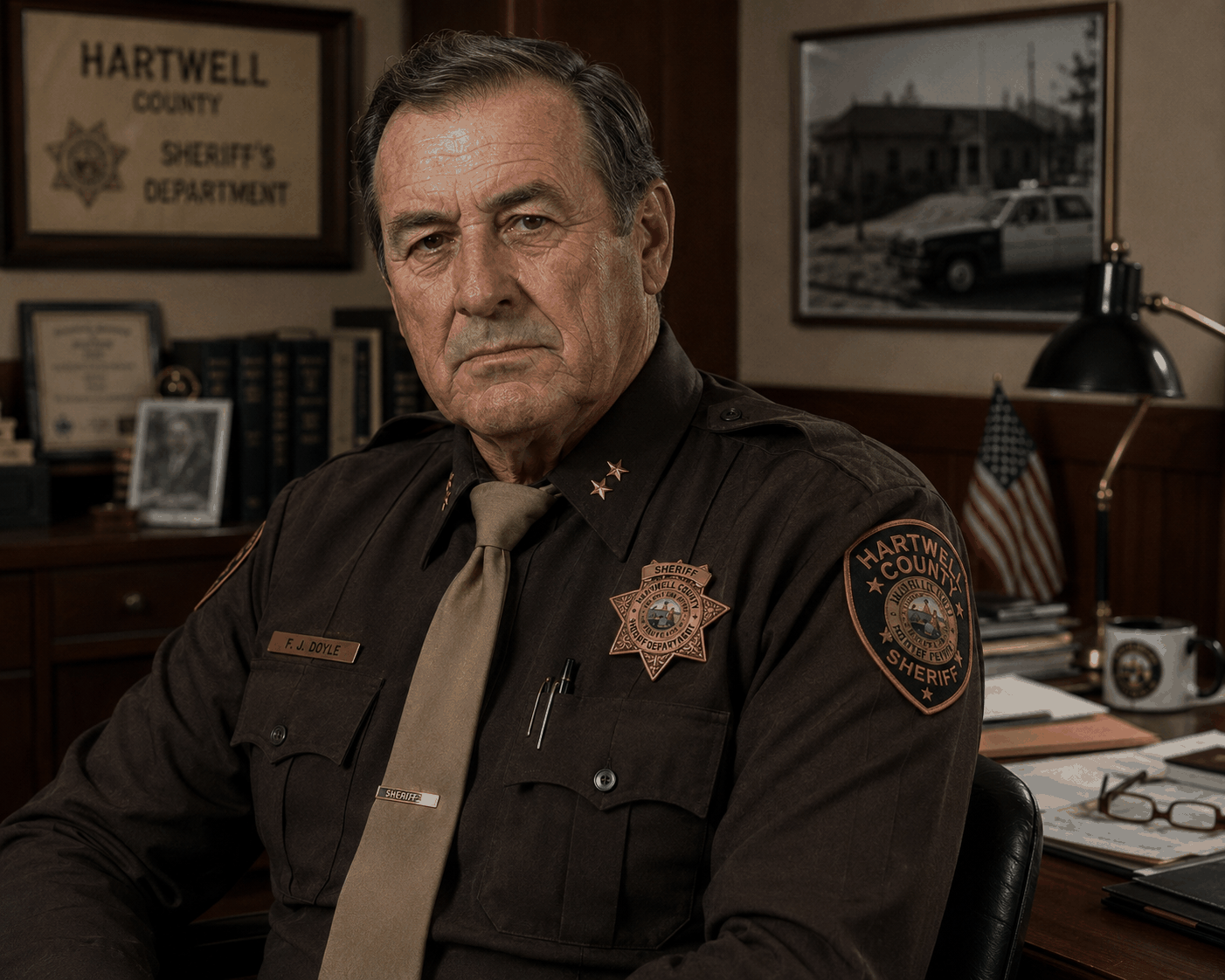 | |
| Franklin James Doyle | |
| Gender | Male |
|---|---|
| Born | March 4, 1937 |
| Birthplace | Briarmont, CA |
| Died | November 3, 2019 |
| Place of Death | Bodega Bay, CA |
| Eyes | Brown |
| Hair | Dark Brown |
| Height | 5'"9 |
| Past ranks | Sheriff |
| Affiliations | Hartwell County Sheriff's Department |
Frank James Doyle — "The Old Guard"
Overview
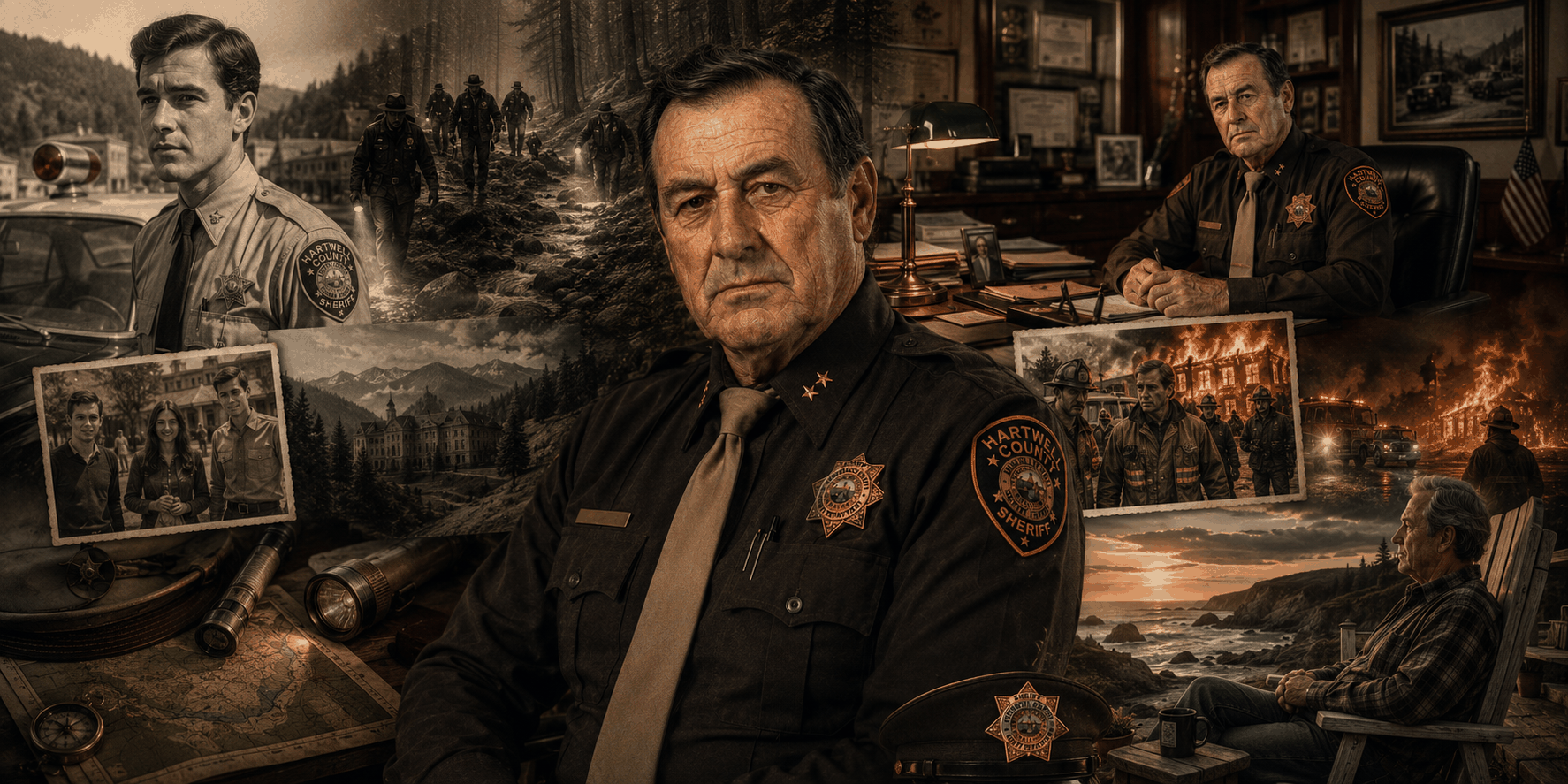
Frank James Doyle spent forty-one years in the Hartwell County Sheriff's Department, rising from a green nineteen-year-old deputy to the office's longest-serving Sheriff of the twentieth century. He was present, as a rookie, for the Bellamy-Humbolt disappearances of 1959 — an event that never left him — and he closed out his career three decades later presiding, imperfectly, over the county's next great unsolved wound: the Phantom Flame arsons. He is remembered less for what he solved than for the steadiness with which he carried what he couldn't, and for the grace with which he stepped aside for the deputy he once doubted.
Early Life
Doyle was born in 1937 in Hartwell County, the son of a mill mechanic and a cannery worker, and grew up in the kind of household where a man's worth was measured in what he showed up for, not what he said about himself. He was raised practical, unsentimental, and Catholic enough to feel guilt but not enough to talk about it. As a boy he ran trap lines with his father along the county's back roads and learned early that the forest above Briarmont kept its own counsel.
He joined the Hartwell County Sheriff's Department in 1959, nineteen years old, largely because it was steady work and his father knew the outgoing Sheriff. He had no particular ambition toward the badge; the badge simply arrived first.
Career / Employment
Deputy
1959–1972
Doyle's first year on the job put him in the search parties combing the north woods for Sheriff Harold Humbolt, President Arthur Bellamy, and the three missing Oakridge students. He never spoke much about those weeks, even decades later, beyond noting that he'd been young enough to think the county would find an answer eventually. It didn't, and something in Doyle settled into a permanent, low-grade patience with unsolved things that would come to define the rest of his career.
The years that followed were unglamorous and thorough: traffic, property disputes, the occasional Oakridge Greek Row disturbance, the slow rhythms of a county more interested in its harbor and its college than in headlines. Doyle earned a reputation as reliable, unhurried, and difficult to rattle — a man who filled out his reports in full sentences and never raised his voice when a level one would do.
Undersheriff
1972–1980
Promoted under Sheriff Humbolt's eventual successor, Doyle spent this stretch as the department's practical backbone — the man newer deputies were sent to when they needed something explained twice. He had little interest in politics and less in ceremony, but he had a gift for making a chain of command feel less like a chain and more like a family that occasionally needed correcting.
Sheriff of Hartwell County
1980–2000
Doyle was elected Sheriff in 1980 and held the office for twenty years, longer than any Sheriff, beside Rebecca Calder, whom held the office for twenty five years. His tenure was defined by steadiness rather than reform — he kept the department running the way it had always run, for better and, eventually, for worse.
That steadiness was tested in the late 1980s, when a string of fires began appearing across the county. Doyle, by his own later admission, was slow to take seriously the theory floated early on by a young firefighter-deputy named Rebecca Calder — that the fires weren't random, but personal, and aimed at one man. He dismissed it, in his own words, as "female dramatizations," a phrase he would spend the rest of his life regretting.
As the fires escalated, Doyle came around to Calder's read of the case, but by then procedure had closed doors that instinct alone couldn't reopen. Without physical evidence tying the fires to a single suspect, there was little he could do but authorize resources and wait for a mistake that never came cleanly enough to prosecute. The case ended, unresolved, with a catastrophic four-alarm fire in 1999 that leveled an apartment building and killed multiple tenants whose identities the county's forensic capabilities of the time could not fully confirm.
Doyle ran for re-election in 2000 anyway. He lost to Calder, and by every account that mattered to him, he was glad to.
Personality
Doyle was old-school in the way that word is meant as a compliment: dutiful, unhurried, allergic to shortcuts. He ran his department the way his father had run a trapline — check every marker, don't skip steps, don't complain about the weather. He was warm in a paternal register, the sort of warmth that showed up as a hand on a shoulder rather than a kind word, and he was hardened enough by four decades of the job that very little surprised him anymore, though plenty of it still kept him up nights.
He was not a demonstrative man, and he was slow — sometimes too slow — to update his instincts once he'd formed them. His skepticism toward Calder's early theories on the Phantom Flame case was, by his own reckoning, the single greatest professional failure of his career, and one he never tried to excuse.
Family
Doyle married Loretta Anne Doyle (née Fisk) in 1961; the two remained married until her death in 2003. They raised three children in Briarmont, none of whom followed him into the department, a fact Doyle claimed to be relieved about and privately wasn't.
Legacy
Frank Doyle is remembered as the last Sheriff of Hartwell County's older era — the bridge between Harold Humbolt's vanished, half-mythic department of the 1950s and the modern, professionalized force Rebecca Calder built after him. He is not remembered as a great reformer. He is remembered as a decent one, a man who did the job in front of him for twenty years and then had the humility, at sixty-three, to recognize that the county's future belonged to someone he had once been too slow to believe.
In his retirement, Doyle lived out his years at a care facility on the Sonoma coast, warm enough in winter to ease his joints, close enough to the water to remind him of home. In 2008, at seventy-one, frail but lucid, he gave what would become his only extended public account of the Phantom Flame years — an interview since regarded as the closest thing Hartwell County has to an official reckoning with a case that was never officially closed.
Quotes
"I've buried better theories than hers on account of nothing more than not liking the shape of 'em. Took me too long to see that was my failing, not hers."
"You spend enough years in these woods, county, you learn the difference between a mystery and a lie. Bellamy taught me that. Took the Phantom to teach me I hadn't learned it near well enough."
Credits
Written by Charles Fairweather
OOC / Tag checklist
Before publishing, set the managed tags on this page (Page > Edit > Tags):
- type — person
- family — [ashton / hale / briggs / hartwell — only if this person belongs to one of the founding families; otherwise leave unset]
- era — [founding for pre-WWII Historical Archive figures, otherwise modern]
- status — [deceased / living]
- stage —
draftto start; move it forward yourself as the piece matures (draft → in-review → needs-work / approved → canon). Human-owned:pipeline.tagsnever touches it. - Family Tree — if this person belongs to a founding family, add them to the Family Tree list on that family’s hub page (Township › Families → the family’s chapter). Person pages never carry their own tree — the website draws each family’s tree from the hub page.
author is auto-derived from the Credits section above by pipeline.tags — do not hand-set it.