
Hartwell County Sheriff's Department
 | |
| Hartwell County Sheriff's Department | |
| Type | Civil Services |
|---|---|
| Motto | Serve, Protect, Uphold |
| Founded | 1859 |
| Leader title | Sheriff |
| Current Sheriff | Nassau Jack Braughler |
| Notable members | Edward Plainview Harold Humbolt Rebecca Calder |
Overview
The Hartwell County Sheriff’s Department is the primary countywide law enforcement agency serving Hartwell County, Briarmont Township, and the surrounding districts of Ashenfall, Brackenridge, Briarmont, Emberglow, Thornmere, and Solarus. Though often treated by outsiders as Briarmont’s local police force, the department’s authority and identity are broader than that. It functions as a county sheriff’s office, with responsibilities extending beyond ordinary patrol work into court security, civil service, investigations, corrections, emergency response, coroner duties, and the preservation of public order across the county.
The department was founded in 1859, one year after the formation of Hartwell County itself. Its creation was closely tied to Elias Hartwell’s consolidation of civic, industrial, and territorial influence in the region. Hartwell had already placed his name on the county, his estate, and much of the economic life surrounding Briarmont. The establishment of a sheriff’s department completed that pattern, giving the county a formal instrument of law and order at a time when authority, land ownership, and private power were often difficult to separate.
The first Sheriff of Hartwell County was Edward Plainview, a figure remembered less for reform or public service than for imposing order during the county’s earliest and most unstable years. Under Plainview, the department served a practical frontier purpose: enforcing warrants, keeping peace between settlers and laborers, protecting property, and responding to violent disputes over land, timber rights, road access, and local jurisdiction. In public records, these conflicts were often described in restrained legal language. In local memory, they remained part of the rougher Hartwell years, when the line between law enforcement and the protection of Hartwell’s interests was not always clean.
Over time, the Hartwell County Sheriff’s Department outgrew its origins. As Briarmont developed from a timber settlement into a civic township and later a college-centered community, the department gradually became a more formal public institution. The establishment of county justice and court services in the early twentieth century, the complications of Prohibition, the growth of Oakridge, and the eventual reorganization of the county court system all expanded the department’s role. By the modern era, especially after the 2001 court reforms transferred former marshal and constable authorities to the Sheriff, the department had become one of the most important public agencies in Hartwell County.
Today, the department publicly presents itself as a professional, community-oriented law enforcement agency committed to protection, service, accountability, and public trust. Its modern identity is shaped by the belief that a sheriff’s office should be more than a collection of deputies in uniform. It is expected to act as a steward of county peace, a partner to the community, and a visible institution of stability in a region whose earliest law enforcement history was anything but neutral.
History
A County in Hartwell’s Image
The history of the Hartwell County Sheriff’s Department begins with Elias Hartwell and the county he shaped around his own ambitions.
Hartwell County was formed in 1858, when Briarmont was still a timber settlement tied closely to Hartwell’s logging interests. By then, Hartwell controlled much of the region’s work, land access, transport, and economic future. Naming the county after himself made official what many residents already understood: Hartwell’s influence had become inseparable from the territory.
The Hartwell County Sheriff’s Department was founded in 1859. Publicly, it existed to preserve peace, enforce the law, carry out warrants, protect property, and respond to violence. In practice, its earliest duties often placed it inside conflicts created by timber expansion, land claims, labor disputes, road access, and the question of who had the right to remain on newly claimed land.
From the beginning, the department was both necessary and compromised. It brought order to a rough county, but that order often favored the people who already held property, money, and influence.
The Plainview Administration
The first Sheriff of Hartwell County was Edward Plainview, appointed in 1859 to organize the new department.
Plainview appears in early county records as disciplined, practical, and severe. Later memory is less generous. He is remembered as a hard man for a hard period: effective at imposing order, but not especially remembered for fairness or mercy.
His department handled ordinary frontier law enforcement: thefts, assaults, drunken violence, camp disputes, warrants, prisoner transport, and protection of county officers. But Plainview’s deputies also enforced the law in a county where the law had been shaped by Hartwell’s interests.
Property claims connected to timber operations received attention quickly. Poorer residents, laborers, Indigenous locals, isolated homesteaders, and others without influence often had fewer protections. The surviving language is usually restrained: trespass, unlawful occupation, resistance, failure to vacate. Behind those words were real people being pushed aside by the county’s new order.
Timber, Land, and Violent Disputes
Between 1859 and 1900, the Sheriff’s Department performed standard rural law enforcement while also managing the conflicts produced by rapid industrial growth.
Deputies responded to fights, theft, missing persons, domestic disturbances, gambling, alcohol-related disorder, worker disputes, and accidents. They also patrolled mills, roads, storage yards, loading points, and the edges of newly claimed land.
The most sensitive work involved land. Later summaries refer to “violent disputes regarding land ownership with locals.” That phrase covers a wide range of conflicts: unclear boundaries, disputed timber access, damaged property, water rights, road construction, and older land use that the county’s new legal system did not always recognize.
The department’s early reputation came from this period. To landholders and business owners, it was a stabilizing force. To others, it could seem like the armed edge of Hartwell’s county government. Both views became part of Briarmont’s memory.
Early Forest Disappearances
The Hartwell years also produced some of Briarmont’s oldest unresolved mysteries.
The disappearances associated with Hartwell Timber Co. were not always formal Sheriff’s Department cases. Records were incomplete, and missing workers were not always treated with urgency. A man might appear in a company ledger, a camp note, a coroner’s record, or nowhere at all.
Two names endured: Nathaniel Vale and Amos Pike.
Vale was remembered as a woodsman and terrain specialist who vanished into the forest. Pike, a scout and surveyor with an eerie reputation among the timber crews, became linked to the legend later known as the Ghost of Briarmont. Their stories belong partly to folklore, partly to company history, and partly to the limits of early law enforcement.
Whether the Sheriff’s Department seriously investigated either disappearance remains uncertain. The county could enforce boundaries, protect equipment, and break up violence when public order required it. But when the forest took a poor man, a strange man, or a man without family demanding answers, the county’s reach became much shorter.
The Decline of Hartwell’s Order
By the 1890s, the world that created the department was changing.
Hartwell Timber Co. remained important, but decades of logging had left visible damage. Hillsides were unstable. Creeks were silted. Salmon runs declined. The most accessible old-growth stands had been depleted, and the company’s momentum slowed.
As the timber economy weakened, Briarmont became more than a work camp. Families stayed. Businesses opened. Civic life developed. The Sheriff’s Department was no longer only enforcing expansion; it was maintaining order in a county learning how to survive after the first timber boom.
The period did not erase the department’s early reputation. Older families remembered who had benefited most from law enforcement in the Hartwell years. Newer civic leaders preferred to speak of maturity and institutional growth. Both versions remained useful, depending on who was telling the story.
Hartwell’s Death and the Legal Unraveling
Elias Hartwell died in 1911, leaving behind property, debts, disputes, and a county still carrying his name.
His death weakened the old personal order that had shaped Hartwell County. Hartwell had been more than a businessman. He had been the center of local industry, land ownership, influence, and civic authority.
Clarence Ashton, executor of Hartwell’s will and one of the key figures behind Hartwell Timber’s operations, became central to the settlement of the estate. His role drew the Sheriff’s Department further into court paperwork, property claims, civil process, and the formal handling of remaining Hartwell interests.
When Ashton died in 1916, another link to the old timber order disappeared. By then, Hartwell County was already moving from personal influence toward institutional authority. The Sheriff’s Department was part of that transition.
The Oakridge Turning Point
In 1918, Hartwell Manor was donated and repurposed for the creation of the Oakridge Institute of Forestry and Land Sciences.
The change had practical consequences for the county. Hartwell’s former estate became the site of Oakridge, bringing new residents, research activity, and institutional oversight that the Sheriff’s Department now had to account for in its daily operations.
For the Sheriff’s Department, Oakridge changed the county. It brought researchers, instructors, students, administrators, visitors, public events, and academic property into Briarmont’s daily life. The department now had to think beyond timber roads, farms, shops, and old family disputes.
Oakridge also preserved records. Surveys, field notes, land studies, and historical documents gave Briarmont new ways to examine its own past. That made the Sheriff’s Department’s early history harder to simplify.
Courts Come to Hartwell County
In January 1919, the State of California selected Hartwell County for formal Justice and County Court services.
Until then, county justice had been more limited and more dependent on local arrangements. The Sheriff’s Department enforced the law, served warrants, held prisoners when necessary, and worked with available county officials. The arrival of court services gave Hartwell County a stronger legal center, but it also changed the balance of local authority.
With the courts came two adjacent elected offices: Marshal and Constable. Both positions were tied to court functions and local enforcement, placing them in close proximity to the Sheriff’s Department, where they could cooperate, compete, and interfere. Hartwell County had long been used to a single dominant law enforcement authority. The addition of Marshal and Constable created a new rivalry within the county’s legal system, especially when personalities, elections, and jurisdictional pride became involved.
By August 1920, Justice and County Court services were available in Hartwell County. This expanded the department’s work into courthouse security, prisoner movement, civil process, warrants, and regular support for judicial officers.
The Sheriff’s Department became more than a field enforcement agency. It became part of the county’s legal machinery, but it now operated alongside other elected offices that could challenge its authority as much as support it.
Prohibition
Prohibition began in January 1920, several months before Hartwell County’s court system became fully active in August of that year.
Briarmont was not naturally suited to dry law. Its timber camps, fishing routes, old roads, private barns, coastal access, and isolated forest paths all made alcohol enforcement difficult. Former logging routes that once moved timber could also move liquor.
The Sheriff’s Department had to enforce an unpopular national law in a county where many residents ignored it. Some stills were raided. Some people were arrested. Others were warned, overlooked, or protected by local relationships.
This period strengthened the department’s reputation as both enforcer and negotiator. In Briarmont, Prohibition was not only about alcohol. It was about how evenly the law would be applied when much of the public did not believe in it.
The Interwar Department
Between Prohibition and the Second World War, the Sheriff’s Department settled into a more recognizable county role.
The timber boom was over. Oakridge was established. Court services were operating. Briarmont had become more stable, civic, and self-aware. Deputies still handled violence, theft, alcohol, family disputes, accidents, and property crime, but their work was increasingly tied to records, court procedure, and civil process.
This was when the department’s dual identity became clearer. It was still a rural sheriff’s office where deputies knew much of the county by name. It was also becoming a formal legal institution.
That familiarity helped deputies work effectively, but it also made impartiality harder. In a small county, law enforcement never operates far from memory, gossip, favors, or resentment.
War, Accreditation, and Mid-Century Growth
The middle decades of the twentieth century brought new expectations. Roads improved, automobiles became central to daily life, and public agencies became more formal. The Sheriff’s Department increasingly handled traffic incidents, investigations, court support, public safety coordination, and emergency response.
Oakridge also changed. The institute expanded beyond its original land-science mission and moved toward a broader academic identity.
In 1947, Oakridge became a California state-accredited college. Arthur Bellamy, associated with accreditation and administrative modernization, was appointed Dean of Academics and Interim President. In public memory, he became the first president of Oakridge College in its accredited form.
Bellamy represented structure, legitimacy, and ambition. His appointment strengthened Oakridge’s public standing, but also marked a shift away from the smaller, field-based institution of its founding years.
For the Sheriff’s Department, Oakridge’s growth meant more regular involvement with students, faculty, visiting families, campus events, and institutional concerns. The college was no longer just an important local institution. It had become one of the central facts of Hartwell County law enforcement.
The Bellamy-Humbolt Disappearances
In September 1959, Arthur Bellamy disappeared in the forests surrounding Briarmont along with three Oakridge students.
The case was immediately serious. Bellamy was tied to Oakridge’s accreditation, modernization, and public reputation. The three students were never named publicly, officially to protect their families. That decision created lasting suspicion.
No bodies were found. No clear trail was established. Searchers found no reliable evidence of violence, accident, or deliberate flight. The forest offered almost nothing useful.
The timing added pressure. Between June 1950 and June 1953, the Selective Service drafts had been activated for the Korean War for men aged eighteen to thirty-five. By 1959, the draft period had passed, but questions about young men, duty, avoidance, trauma, and institutional responsibility still lingered. Rumors formed quickly: flight, accident, hazing, scandal, or something Bellamy had tried to handle quietly.
Then Sheriff Harold “Hal” Humbolt disappeared in mid-September 1959 while the investigation was still active. His badge was later found in the forest. No body, weapon, note, blood trail, or conclusive evidence was recovered.
The missing badge changed the case. A college president's disappearance was alarming. A Sheriff vanishing while investigating him became legendary.
Humbolt’s rivals, Marshal Hallifax Tooms and Constable Joshua Lightfoot, were both near enough to county law enforcement to attract speculation. In 1960, neither sought re-election. No public evidence linked them to the disappearances, but their exits deepened public unease.
In 1962, the disappearances of Arthur Bellamy, Sheriff Harold “Hal” Humbolt, and the three unnamed Oakridge students were designated as cold cases.
The Forest in County Memory
The Bellamy-Humbolt case changed how Briarmont understood its older forest stories.
Before 1959, tales of Nathaniel Vale, Amos Pike, and the Ghost of Briarmont belonged mostly to the Hartwell era. They could be treated as old folklore: rough camps, bad records, superstition, illness, and men lost before modern search methods existed.
Bellamy and Humbolt made the pattern feel current. This was a modern case involving an accredited college president, three students, an active Sheriff, elected lawmen, search parties, and public scrutiny. Yet it ended much like the older stories: people entered the forest, and the county was left with their absence.
For the HCSD, the forest cases became a lesson in institutional limits. The department could patrol roads, serve warrants, secure courts, and investigate crimes. But in the deep forest, terrain, weather, isolation, and silence could defeat procedure.
The College and the Town
After the Bellamy-Humbolt disappearances, the relationship between the Sheriff’s Department and Oakridge became more careful.
Oakridge brought money, students, faculty, visitors, public events, and attention. It also brought alcohol violations, accidents, protests, vandalism, mental health calls, missing-student reports, fraternity and sorority incidents, and disputes between students and residents.
The department had to balance several expectations. Residents wanted students controlled. Administrators wanted discretion. Students wanted safety without feeling watched. Parents wanted reassurance. Local businesses wanted student spending without student disorder.
The Bellamy-Humbolt case made serious college incidents harder to treat as internal matters. When campus problems crossed into public safety, the Sheriff’s Department was expected to act.
This balancing act eventually shaped the modern School Resource and College Response role. Oakridge was not an ordinary neighborhood. It was a community within the community, with its own politics, risks, and reputation.
Reform of the Courts
In 2001, the Justice and County Courts in Hartwell County were folded into the Hartwell County Superior Court.
As part of that reform, the authority and duties formerly associated with the Marshal and Constable were transferred to the Sheriff of Hartwell County. This made the Sheriff’s Office the central agency for court protection, civil services, prisoner movement, warrants, service of process, and related county enforcement duties.
The change also altered the historical meaning of offices once held by men such as Marshal Hallifax Tooms and Constable Joshua Lightfoot. Earlier generations had lived with several overlapping centers of legal authority. After 2001, much of that authority was consolidated under the Sheriff.
This is one reason the modern HCSD describes itself as a “Police-Plus” agency. It is not only a patrol force. It is the county’s law enforcement, court-support, civil-service, emergency-response, and community-protection institution.
The Modern Hartwell County Sheriff’s Department
The modern Hartwell County Sheriff’s Department presents itself very differently from the department Edward Plainview first led in 1859.
Its public identity emphasizes service, accountability, professionalism, constitutional rights, public trust, crime prevention, and community partnership. It serves Hartwell County, Briarmont Township, and the districts of Ashenfall, Brackenridge, Briarmont, Emberglow, Thornmere, and Solarus.
Its duties now include patrol, investigations, court services, civil process, emergency management, coroner coordination, traffic response, college response, crisis intervention, and specialized operations.
Even so, the department still carries the weight of its history. It began in a county named for a man who treated land, industry, civic order, and legacy as extensions of himself. It also carries the memory of cases it could not close: Nathaniel Vale, Amos Pike, Arthur Bellamy, Harold Humbolt, and the three unnamed Oakridge students.
The modern department’s mission can be read as an answer to that inheritance. To protect and serve. To earn trust through compassion and accountability. To preserve peace through partnership rather than intimidation.
What is certain is that the Hartwell County Sheriff’s Department remains one of Briarmont’s oldest and most consequential institutions. It has stood through timber expansion, land conflict, unsolved disappearances, Hartwell’s death, the founding of Oakridge, Prohibition, court expansion, Oakridge’s accreditation, the Bellamy-Humbolt cold cases, modern court reform, and the continuing effort to define justice in a county built on complicated ground.
Structure
The Hartwell County Sheriff’s Department is led by the Sheriff of Hartwell County, who serves as the department’s chief executive officer and final authority on matters of policy, operations, discipline, and departmental organization. The Sheriff holds the combined modern responsibilities of sheriff, coroner, and the former county marshal and constable functions that were folded into the office after the 2001 court reforms.
Beneath the Sheriff, the chain of command proceeds through the Undersheriff, Captain or Chief Deputy, Lieutenants, Sergeants, Detectives, Senior Deputies or Corporals, Deputy Sheriffs, and non-sworn office personnel. This hierarchy is intended to preserve clear command, accountability, supervision, and communication throughout the department.
The Undersheriff serves as second-in-command and may assume the duties of the Sheriff during temporary absences. In the modern department, the Undersheriff also holds an important role in the School Resource and College Response Bureau, reflecting the department’s close operational relationship with Oakridge College and the wider student community.
The Captain, also referred to as the Chief Deputy, serves as third-in-command and assists in the management of department operations, staff coordination, policy implementation, special events, major incidents, training needs, citizen complaints, and interagency cooperation. Lieutenants and Sergeants manage divisions, review reports, supervise personnel, and ensure that daily operations remain consistent with department policy.
The department is organized into several bureaus and specialized divisions:
- Administration Bureau: Oversees department leadership, policy direction, internal administration, training, professional standards, records, public information, personnel functions, and coroner-related coordination.
- Patrol Bureau: Provides general law enforcement response across Hartwell County and its districts, including vehicle patrols, foot patrols, mounted patrols, traffic enforcement, and regular calls for service.
- Civil Services Bureau and Court Protection Division: Handles courthouse security, courtroom order, prisoner movement, civil process service, warrants, and support for the Hartwell County Superior Court.
- Major Crimes Bureau: Investigates serious crimes and complex cases beyond the ordinary scope of patrol work, including homicides, sexual assaults, armed robberies, home invasions, vice and narcotics matters, missing persons, and specialized investigative assignments.
- School Resource and College Response Bureau: Focuses on Oakridge College, Greek Row, student safety, college-related incidents, and cooperation with college administration.
- Crisis Response and Special Weapons and Tactics: Provides specialized response to high-risk warrants, hostage situations, active threats, barricaded suspects, and other major incidents requiring advanced tactical coordination.
Non-sworn staff also play a crucial part in the department’s daily operations. Office personnel serve as the public’s first point of contact, assisting with records and communications, directing inquiries, supporting department administration, and helping maintain continuity between sworn deputies, county offices, and the public.
This structure reflects the department’s broad county role. The HCSD is not simply a patrol agency. It is a sheriff’s office, a court-support agency, an investigative body, a coroner-linked office, an emergency response partner, and a community-facing institution with responsibilities that stretch across both Briarmont’s public life and Hartwell County’s wider legal framework.
Public agenda
The Hartwell County Sheriff’s Department publicly presents itself as a law enforcement agency dedicated to protecting life and property, preserving peace, preventing crime, investigating offenses, supporting the courts, and maintaining public trust throughout Hartwell County.
Its stated purpose is to protect and serve the community through compassion, accountability, professionalism, and partnership. The department emphasizes public safety, crime prevention, problem solving, constitutional rights, community engagement, and the belief that trust between deputies and residents is essential to effective law enforcement.
The department’s modern public agenda can be understood through five broad commitments:
- Protection: The department seeks to safeguard residents, visitors, students, businesses, public spaces, and county institutions from crime, disorder, emergency threats, and preventable harm.
- Prevention: The department places emphasis on reducing crime before it occurs through patrol visibility, community relationships, public education, early intervention, and coordination with other agencies.
- Problem Solving: The HCSD presents itself as a practical agency expected to respond to the specific needs of a rural-suburban county. Its work includes not only arrests and investigations, but also disputes, welfare concerns, civil matters, traffic issues, public events, crisis response, and college-related safety concerns.
- Partnership: The department’s public role depends on cooperation with Hartwell County government, Briarmont Township, Oakridge College, the Superior Court, emergency services, civic organizations, and residents across all districts.
- Public Trust: The department’s modern identity depends heavily on accountability, professional conduct, restraint, fairness, and the careful use of lawful authority. This is especially important given the department’s origins, when law enforcement in Hartwell County was closely tied to property disputes, private influence, and the harsh realities of frontier settlement.
In the public version of its history, the Hartwell County Sheriff’s Department is an institution that matured alongside the county it serves. It began as a frontier sheriff’s office created in the shadow of Elias Hartwell’s ambition, passed through eras of timber wealth, land conflict, Prohibition, court expansion, college growth, and modern legal reform, and eventually became a broad public safety agency responsible for much more than ordinary policing.
Briarmont’s older families tend to remember that history with a degree of nuance. In its earliest decades, the department operated in a time when questions of land, authority, and influence were still being settled, and its role reflected the realities of that period. Over time, the HCSD has worked to shape a more clearly defined public identity: as a steward of peace, a partner to the community, and an agency whose authority is grounded in service to the people it protects.
Assets
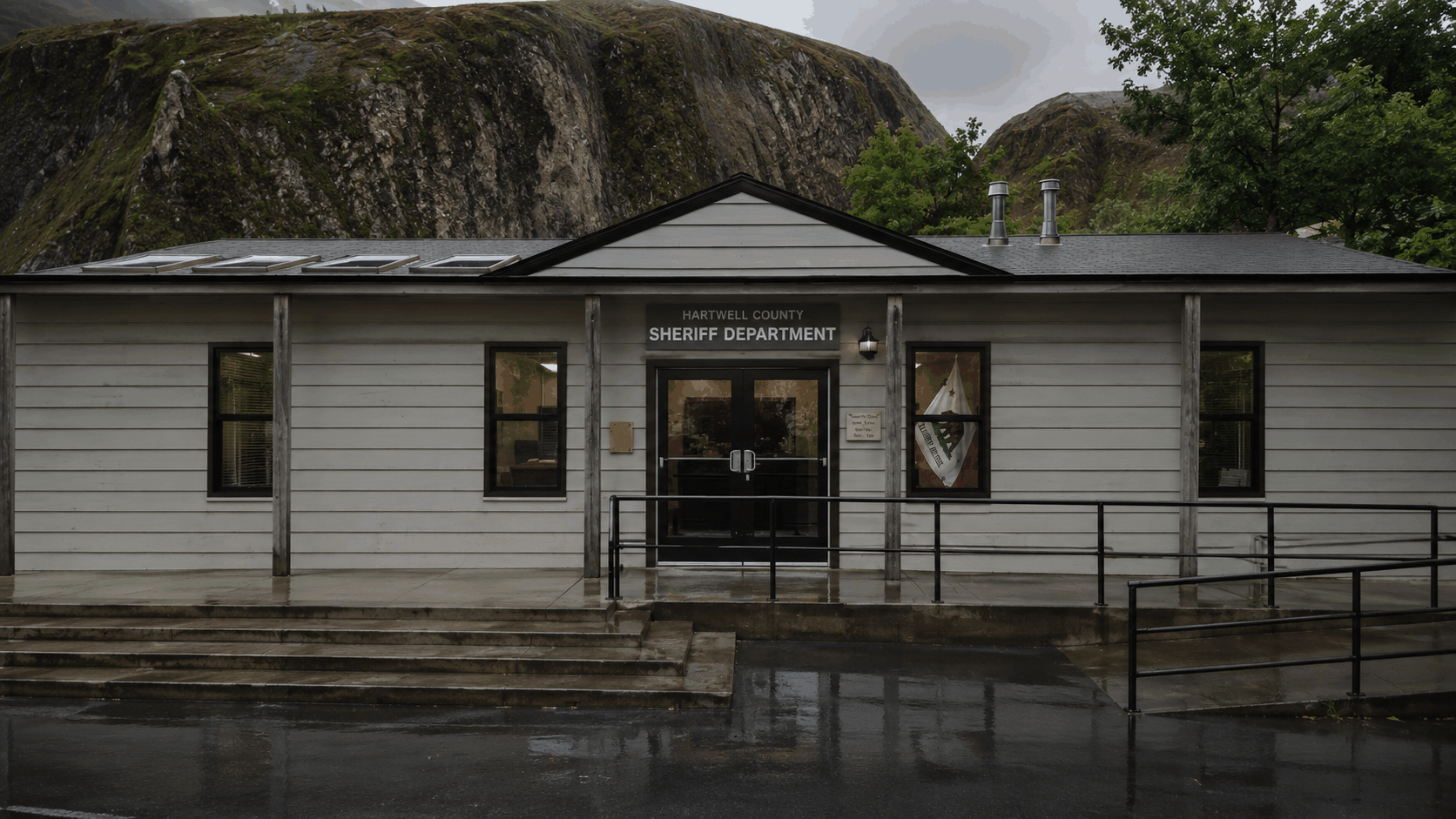
The Hartwell County Sheriff’s Department’s most visible modern asset is its headquarters building, a low, practical county structure with a gray exterior, black trim, central entrance, public signage, and accessible front ramp. It serves as the department’s public-facing center, housing reception, command offices, records functions, patrol coordination, interview and report spaces, and daily administrative operations.
The department also maintains the standard resources of a modern sheriff’s office, including marked and authorized unmarked vehicles, communications equipment, case files, civil records, evidence and property storage, traffic enforcement tools, emergency response equipment, and resources used for patrol, investigations, court services, and crisis incidents.
One of the HCSD’s most distinctive assets is its Mounted Patrol Unit, formed by Sheriff Harold “Hal” Humbolt before his disappearance in 1959. Mounted deputies are used for public visibility, special events, crowd management, traffic and parking control, ceremonial appearances, rural patrol, and areas where horseback access remains useful.
Through its Civil Services Bureau and Court Protection Division, the department also maintains operational ties to the Hartwell County Superior Court, including courthouse security, courtroom support, civil process service, warrant service, prisoner handling, and movement between custody and court appearances.
The department’s records are another major institutional asset. Case files, cold case material, civil documents, court-service records, property records, and historical law enforcement files connect the modern HCSD to more than a century and a half of Hartwell County history.
Ranks & Positions
| Sheriff |