
Elias Hartwell's Will & Testament
| Elias Hartwell's Will & Testament | |
| Type | Record, Historical |
|---|---|
| Executor | Clarence Ashton |
| Related Location | Hartwell Manor |
Overview
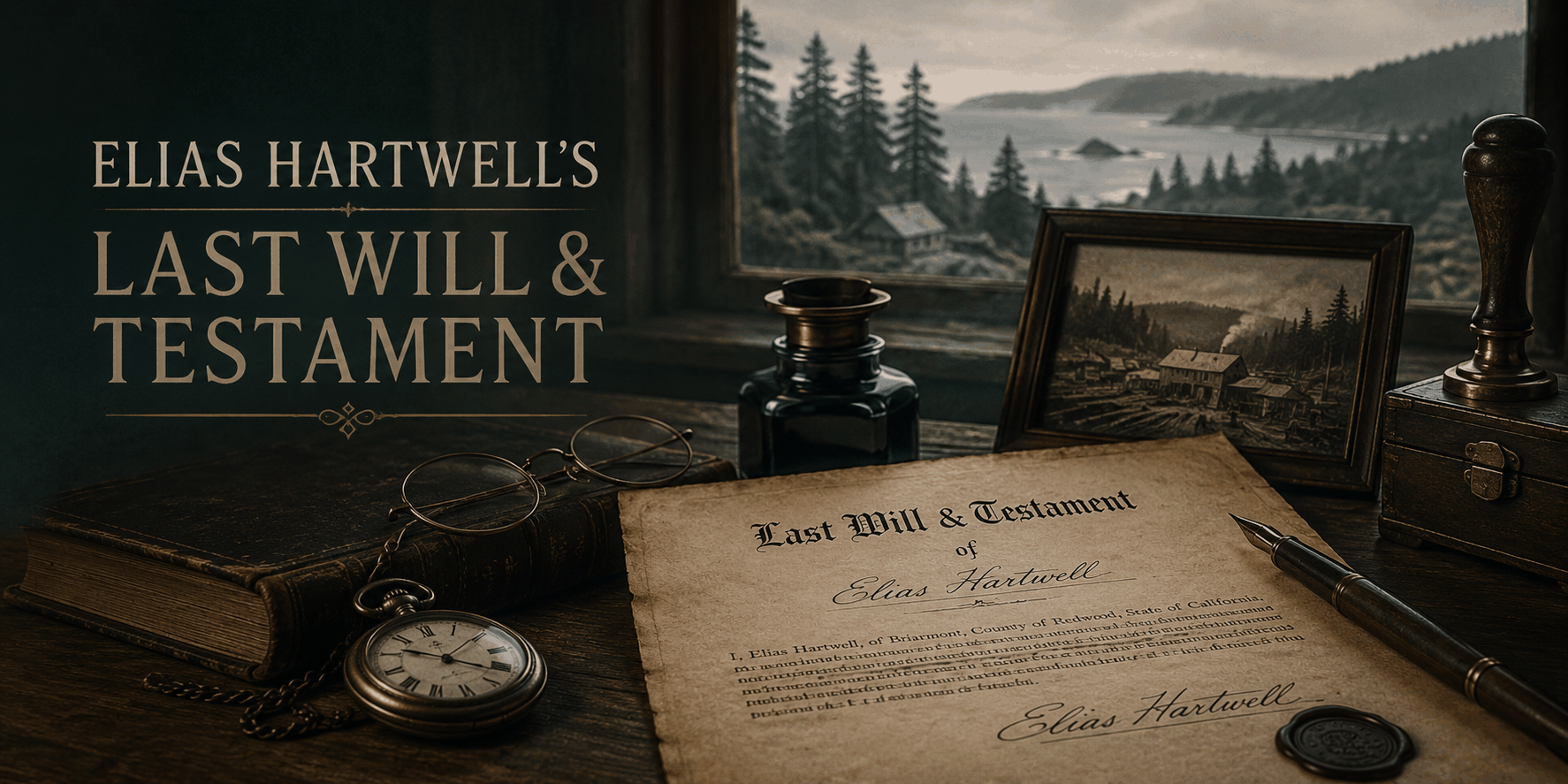
The Last Will and Testament of Elias Hartwell is one of the most consequential legal documents in Briarmont’s history. In its accepted form, the will brought Hartwell Timber Company to a formal end, placed Hartwell Manor into a long period of civic uncertainty, and made possible the eventual founding of Oakridge Institute of Forestry and Land Sciences.
To most residents, the will is remembered as the document that turned Hartwell’s private estate away from timber and toward public use. It is often treated as the first legal step in Briarmont’s slow attempt to answer the damage Hartwell Timber had left behind.
Background
By the time Elias Hartwell died in 1911, Hartwell Timber Company was no longer the unstoppable force it had been during Briarmont’s early decades. The most accessible timber stands had been depleted, production had slowed, debts had mounted, and the environmental consequences of decades of cutting had become increasingly difficult to ignore. Hillsides had been stripped bare. Creeks were silted. Salmon runs had declined. The town that Hartwell had helped build was also living with the cost of what his company had taken.
Hartwell had no wife, no children, and no direct heir to inherit either the estate or the company. This made his will more than a private legal matter. It determined the future of Hartwell Manor, the remaining company assets, and much of the land that would later become central to Briarmont’s civic and academic identity.
The accepted will did not preserve Hartwell Timber Company. Instead, it directed that debts be settled, company assets sold, and the remaining estate placed toward the use and betterment of Briarmont and its people.
For a man so closely associated with expansion, ownership, and command, the phrasing has long been treated as notable.
Contents of the Accepted Will
The accepted version of Hartwell’s will was comparatively brief by the standards of the estate it governed. It directed that outstanding debts, taxes, and obligations be settled through the sale of company equipment, timber rights, movable assets, and other property not attached to the manor grounds.
Once creditors had been answered, Hartwell Manor and its surrounding estate were not assigned to a private heir. Instead, the remaining property was left, in broad terms, for the “use and betterment of Briarmont and its people.”
That phrase became the center of years of legal and civic interpretation.
The will did not clearly specify whether the manor should become a school, municipal building, charitable institution, park, archive, or some other public use. Nor did it provide detailed instructions for how the land should be managed. As a result, the estate entered a period of administrative limbo after Hartwell’s death, caught between creditors, local officials, legal interpretation, and the practical difficulty of converting a private industrial estate into a civic resource.
Clarence Ashton as Executor
Elias Hartwell named Clarence Ashton as executor of his estate. At the time, the choice was considered practical and unsurprising. Ashton had served Hartwell for decades and knew the company’s accounts, contracts, timber holdings, machinery, debts, routes, camps, and records better than any other surviving officer.
If Hartwell Timber Company was to be dismantled, inventoried, defended from creditors, or converted into cash, Clarence Ashton was one of the few men capable of doing it.
His appointment placed him at the center of the estate’s earliest administration. He answered creditors, reviewed company obligations, identified assets, separated private holdings from business property, and helped determine which records belonged to Hartwell’s estate, which belonged to the company, and which might eventually pass into civic custody.
In official histories, Ashton’s role is usually described as administrative. He was the necessary man in a difficult settlement.
Even so, his position gave him extraordinary access. The will, the company ledgers, Hartwell’s correspondence, the estate inventories, and the practical interpretation of Hartwell’s final instructions all passed through his hands.
Delay of Settlement
The settlement of Hartwell’s estate did not move quickly. The company’s debts were substantial, its records complex, and the charitable language of the will broad enough to invite argument. Several matters remained unresolved for years after Hartwell’s death.
When Clarence Ashton died in 1916, the process slowed almost to a standstill.
As executor, Ashton had personally supervised much of the estate’s organization. His death left clerks, creditors, civic officials, and later trustees to reconstruct decisions that had depended on his knowledge of Hartwell Timber’s internal workings. Inventories had to be checked. Earlier classifications had to be reviewed. Missing or incomplete papers had to be explained as best they could. Records that Ashton had handled directly did not always pass cleanly into later custody.
This interruption delayed the final civic handling of Hartwell’s estate for nearly two more years.
Later histories usually describe the delay as an unfortunate administrative complication: an old estate, a collapsed company, heavy debts, incomplete records, and the death of the one man who understood the whole machinery of Hartwell Timber. That explanation remains the accepted one.
It is also the point at which the document trail becomes least tidy.
Transfer into Civic Trust
After the delay, the remaining estate passed more fully into Briarmont’s civic process. Hartwell Manor and its grounds were no longer a functioning company seat, but they were not yet Oakridge. For a time, the property existed in an awkward middle state: too symbolically important to sell casually, too damaged and expensive to maintain easily, and too vaguely assigned to be used without argument.
The manor stood largely idle while town officials, trustees, creditors, and civic voices debated what Hartwell’s final language actually required. Some favored practical municipal use. Others argued for education, preservation, or land study. Still others saw the estate as a burden Briarmont had inherited from the very man who had helped create the town’s wounds.
In time, the broad language of the will became useful precisely because it was vague. “Use and betterment” could be made to mean more than charity. It could mean repair.
Founding of Oakridge
In 1918, the Briarmont trust formally established Oakridge Institute of Forestry and Land Sciences on the former Hartwell estate. The choice gave Hartwell Manor a new purpose and tied the estate directly to the study of the environmental damage Hartwell Timber had helped cause.
Oakridge’s founding mission centered on forestry, land management, watershed recovery, erosion control, and the long-term stewardship of the redwood landscape. The estate that had once symbolized extraction became the institutional center of research, restoration, and public memory.
This transformation became one of Briarmont’s preferred historical arcs: the timber baron’s estate turned toward the repair of timber’s damage.
The will made that story possible.
Unusual Features
Although the accepted will has long been treated as legally valid, several features have drawn quiet interest from local historians and archivists.
The first is its tone. Hartwell was not remembered as a sentimental or civic-minded man. His surviving business reputation suggests someone concerned with control, profit, obligation, and the preservation of what he had built. The will’s broad language about Briarmont’s betterment is not impossible, especially given the visible decline of the company in his later years, but it does sit uneasily beside the harder record of his life.
The second is the condition of the archival trail. Early references to the will do not always use identical wording. Some civic summaries quote the betterment clause slightly differently. Probate references are incomplete in places. Later Oakridge accounts present the document confidently, but not always with a clear explanation of which copy they relied upon.
The third is Clarence Ashton’s role. As executor, Ashton was the necessary interpreter of Hartwell’s estate. He had access to the papers, the ledgers, the creditors, the company records, and the early handling of the will itself. His death in 1916 created a break in the settlement process at exactly the point when Hartwell’s final intentions were still being sorted, copied, preserved, and explained.
None of these details proves wrongdoing.
Together, they have made the will one of Briarmont’s most quietly debated documents.
Surviving Copies and Archival Notes
The version most commonly cited today is the accepted civic copy preserved through Oakridge’s archival tradition. This is the text used in most public histories of Hartwell Manor, Hartwell Timber Company, and the founding of Oakridge.
A probate copy is believed to have existed in county records, though later references to it are incomplete. Some summaries appear to have been copied from extracts rather than the full instrument. Hartwell Timber’s internal office copy, if one was kept, has not survived in any confirmed form.
Several early inventories mention estate papers, company contracts, personal correspondence, and memoranda removed from Hartwell Manor during the settlement period. Not all of those materials can be matched to surviving archival boxes.
For this reason, Elias Hartwell’s will remains both a foundation and a problem. Its legal consequences are clear. Hartwell Timber ended. The estate entered civic hands. Oakridge was eventually founded on the land.
What remains less clear is how cleanly the accepted document passed from Hartwell’s desk into Briarmont’s history.
Legacy
The Last Will and Testament of Elias Hartwell reshaped Briarmont. It ended the direct power of Hartwell Timber Company, preserved Hartwell Manor from private sale, and created the legal opening through which Oakridge could eventually emerge.
It also gave Briarmont one of its most enduring stories of transformation: a town wounded by extraction receiving, from the estate of the man most associated with that extraction, the means to study and repair the land.
Whether that story reflects Hartwell’s final conscience, legal convenience, civic interpretation, or something less easily named remains a matter of quiet debate.