
Clarence Ashton
 | |
| Clarence Ashton | |
| Born | March 18th, 1829 |
|---|---|
| Birthplace | Providence, RI |
| Died | October 17th, 1916 |
| Place of death | Briarmont, CA |
| Spouse | Margaret Ellery Ashton |
| Parents | Samuel AshtonRebecca Hale Ashton |
| Children | Benedict Ellery Ashton |
| Gender | Male |
| Eyes | Brown |
| Hair | Dark Brown |
| Height | 5'9" |
| Organization | Hartwell Timber Co. |
Overview
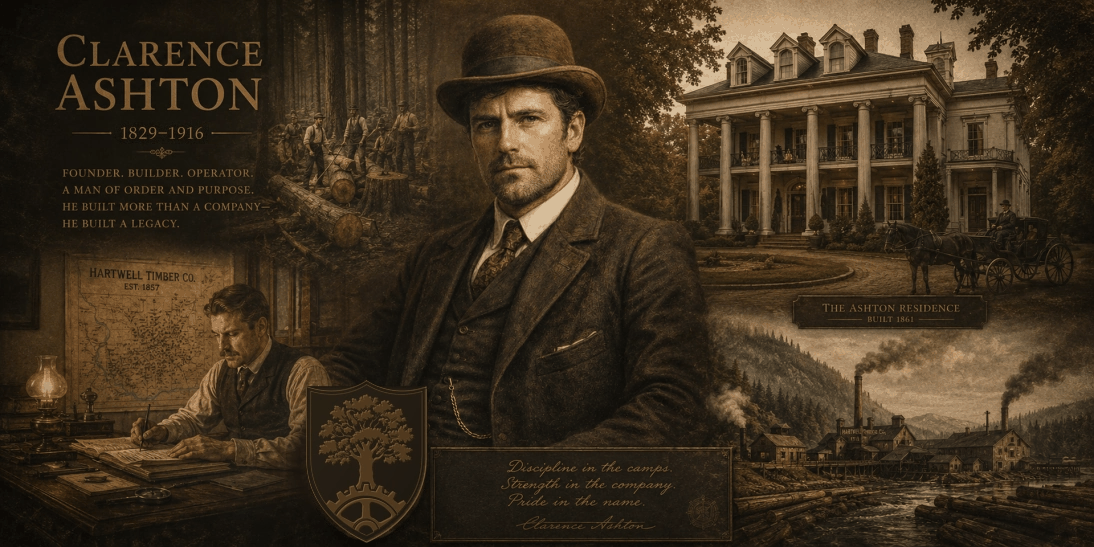
Clarence Ashton was one of the original eight men of the Hartwell Timber Company and served as its early head of operations. While Elias Hartwell supplied the ambition and capital behind the company’s rise, Ashton was among the men responsible for turning that ambition into a working system. He coordinated camp logistics, labor assignments, supply chains, transport schedules, and the movement of timber from forest to mill, helping impose order on what might otherwise have remained a rough frontier venture.
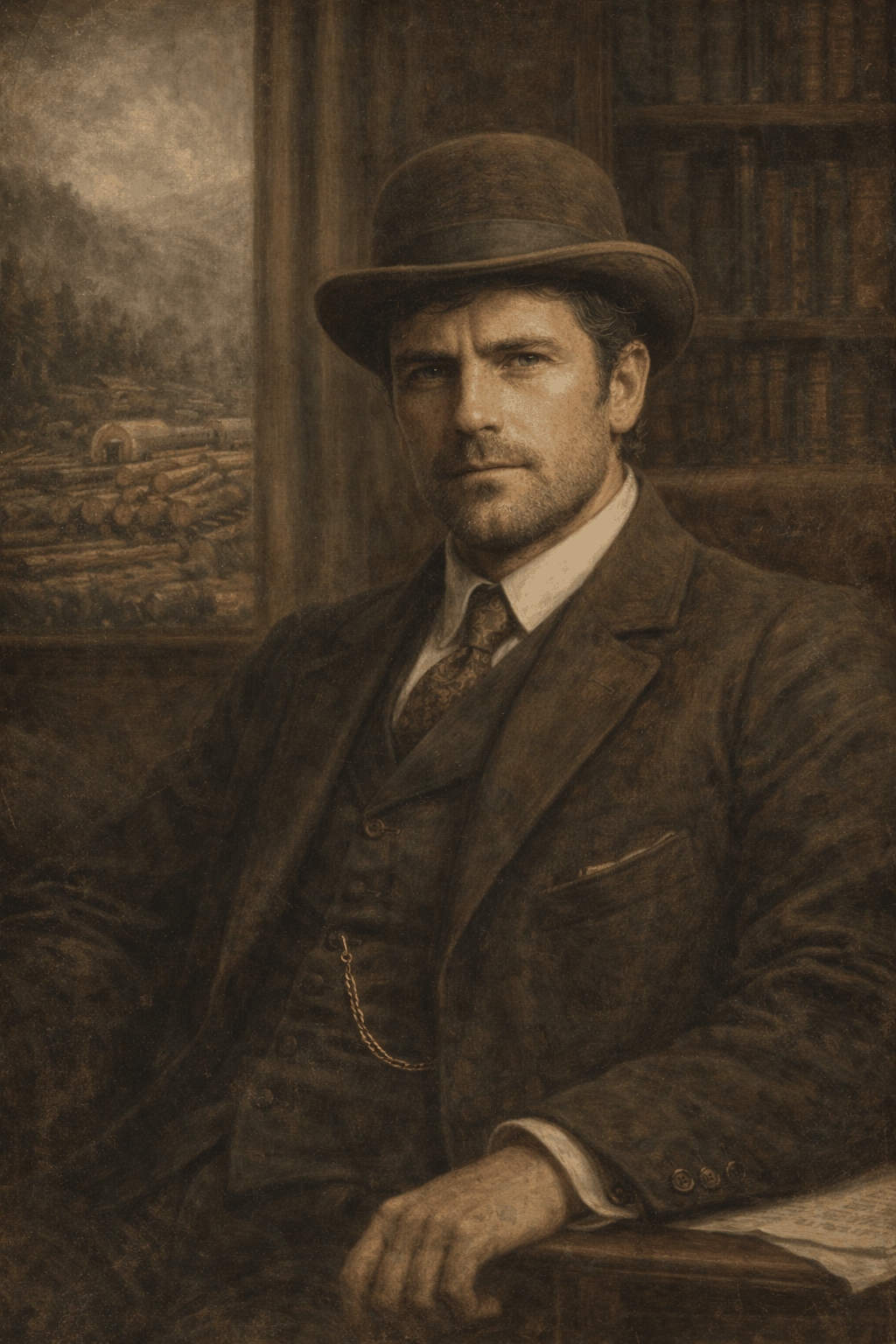
By all accounts, Ashton was disciplined, exacting, and difficult to rattle. He believed in routine, clear hierarchies, and the kind of practical efficiency that kept men working and timber moving even in unstable conditions. Workers did not always like him, but they respected him. In later local memory, he was remembered less as a visionary than as the man who made Hartwell’s expansion possible.
That legacy, however, was not an innocent one. Clarence Ashton’s competence was bound to the same industrial system that stripped hillsides, silted creeks, and helped reduce the region’s old-growth forests to fragments. The Ashton name endured in Briarmont as one associated with management, discipline, and respectability, but also with the cost of making Hartwell’s enterprise function at scale.
By the time Ward Ashton arrived at Oakridge Institute in 1919, that family connection had hardened into a burden. Ward, the nephew of a former Hartwell Timber operations associate, came to the institute carrying an unspoken expectation that he might somehow help repair what his family’s connection to Hartwell had helped damage, or at the very least avoid adding to it.
Education
Little is known about Clarence Ashton’s early education before he came west with his parents as a teenager. No surviving record suggests that he received a formal college education, and later accounts generally describe him as a man shaped more by work, observation, and practical necessity than by schooling.
Clarence appears to have possessed a strong natural aptitude for figures, logistics, machinery, and command. He learned quickly in the field, developing an instinctive understanding of timber operations, transport routes, labor management, equipment, weather, cost, and risk. What others studied in books, Clarence learned through exposure, repetition, and consequence.
His lack of formal education did not limit his rise. If anything, it contributed to the hard practicality that later defined him. Clarence valued knowledge that could be used immediately: a correct account, a repaired line, a reliable crew, a road cut in the right place, a shipment delivered on time. He had little patience for theory unless it could prove its worth in work.
By the time Clarence entered Hartwell Timber’s inner circle, he had acquired the kind of education the company valued most. He could read a ledger, judge a crew, count the cost of a delay, and look at a ridge line as a problem to be solved rather than admired. Elias Hartwell did not trust him because Clarence was refined. He trusted him because Clarence was useful, exacting, and seldom wrong twice.
Career / Employment
Hartwell Timber Laborer
1847–1853
Clarence Ashton entered Elias Hartwell’s employ in 1847, when he was still a young man and Hartwell’s operations were far from the powerful company they would later become. His earliest work was likely practical and physically demanding: hauling, camp labor, road work, supply movement, and whatever else was needed in a growing timber enterprise. These years gave Clarence his first education in the realities of the trade and brought him under Hartwell’s notice.
Timber Crew Foreman
1853–1862
By the 1850s, Clarence had risen into a supervisory role. He proved capable of managing men, schedules, tools, animals, and difficult terrain with unusual discipline. He was not known for charm, but he was known for order. Under his direction, crews worked efficiently, equipment was accounted for, and delays were treated as problems to be solved rather than excuses to be accepted.
Operations Supervisor, Hartwell Timber Company
1862–1878
As Hartwell Timber expanded, Clarence became increasingly involved in the company’s broader operations. He helped coordinate cutting sites, transport routes, milling schedules, camp closures, supply lines, and labor assignments. This period marked his shift from field authority to company command. He learned not only how timber was cut, but how a town, a workforce, and a landscape could be organized around extraction.
Head of Operations, Hartwell Timber Company
1878–1911
Clarence eventually became Hartwell Timber’s Head of Operations and Elias Hartwell’s most trusted working officer. He stood closer to the machinery of the company than any other man, managing the practical systems that kept Hartwell’s ambitions moving. By the later years of the company, Clarence understood both its power and its damage: the declining timber stands, unstable hillsides, damaged waterways, labor pressures, debt, and contracts that tied Briarmont to a fading industry.
Clarence remained in Hartwell’s service until Elias Hartwell’s death in 1911. By then, he had spent more than six decades inside the company. His career had made him indispensable, wealthy, respected, and feared. It had also made him one of the few people who fully understood what Hartwell Timber had built, what it had destroyed, and what it might still do if no one stopped it.
Personality
Clarence Ashton was a hard man, but not a simple one. Publicly, he was remembered as disciplined, severe, and exacting: a man of ledgers, contracts, timber schedules, and command. As Head of Operations for Hartwell Timber Company, he understood men, machinery, weather, distance, cost, and consequence with a precision that made him indispensable to Elias Hartwell and difficult for others to challenge.
Yet Clarence was not born cold, nor was he incapable of tenderness. In private, especially in his younger years, he could be affectionate with those few people who softened him. His wife saw a side of him that Briarmont rarely did: attentive, protective, and capable of quiet warmth. When his son Benedict was very young, Clarence could be gentle with him as well, showing flashes of the father he might have been under different circumstances.
That tenderness did not survive easily.
As Hartwell Timber expanded and the damage to Briarmont became harder to ignore, Clarence grew colder. The pressures of Elias Hartwell’s greed, the company’s decline, the town’s dependence on timber, and the visible destruction of the land hardened him year by year. What may once have been discipline became rigidity. What may once have been protectiveness became control. He came to value usefulness over sensitivity, obedience over honesty, and silence over grief.
This change shaped his family deeply. Benedict, gentle and artistic by nature, became a disappointment Clarence did not know how to love properly. Edmund learned the habits of duty and deference. Ward, born later into the family’s shadow, became the vessel Clarence selected for the future of the Ashton name. In each case, Clarence’s affection was filtered through expectation, and his expectations became increasingly merciless with age.
By the end of his life, Clarence Ashton was a man defined by contradiction: capable of love, but poor at preserving it; capable of recognizing damage, but unwilling to confess his part in it; capable of saving Briarmont from further ruin, but only through secrecy, force, and control. He was not merely cruel, and he was not merely tragic. He was a man who hardened himself to survive the machinery he helped build, then mistook that hardness for strength.
Legacy
Clarence Ashton’s legacy in Briarmont is difficult to separate from Hartwell Timber Company. For more than six decades, he served Elias Hartwell’s enterprise, rising from practical labor to Head of Operations and becoming one of the men most responsible for turning Hartwell’s ambitions into physical reality. Roads, camps, mills, timber routes, payrolls, and schedules all passed through systems Clarence helped maintain.
Publicly, he was remembered as disciplined, capable, and severe. He was the kind of man Briarmont respected even when it did not love him: exacting, reliable, difficult to impress, and nearly impossible to ignore. His reputation rested on competence. If Elias Hartwell represented appetite, Clarence represented machinery.
That reputation carried a darker weight as Briarmont later reckoned with the damage Hartwell Timber had caused. Clarence had not merely witnessed the stripped hillsides, unstable slopes, damaged waterways, and decline of the salmon runs. He had helped organize the work that produced them. Even when later accounts credited him with preventing further ruin after Hartwell’s death, that credit remained complicated by the fact that Clarence had spent most of his life serving the same destruction he eventually helped end.
Within the Ashton family, Clarence’s legacy was even more painful. His authority shaped the lives of Edmund, Benedict, and Ward long after his death. Benedict, his only son, was overlooked, judged unsuitable, and ultimately passed over in Clarence’s will. Edmund was left to maintain a house he did not inherit. Ward, still a boy, was made heir to the Ashton Residence and to the burden of a family name already stained by Hartwell Timber.
Clarence’s decision to leave the Ashton Residence to Ward became one of the defining acts of the Ashton family’s later history. Publicly, it was explained as a choice to pass the house forward to the next generation. Privately, it revealed Clarence’s habit of deciding which members of his family counted, which futures were acceptable, and which wounds could be hidden beneath duty.
In Briarmont’s broader history, Clarence remains a figure of contradiction. He was capable of tenderness, but became increasingly cold. He understood damage, but had helped cause it. He may have saved Briarmont from Elias Hartwell’s final ambitions, but only through control, secrecy, and silence. His life left behind no simple moral lesson, only a harder truth: some men help build the ruin, then are remembered for knowing where the machinery had to stop.
Quotes
"The Ashton name carries a standard, not a sentiment. Some branches are not meant to be seen."
Credits
Written by: Charles Fairweather