
Eliza Harrow Ashton
 | |
| Eliza Harrow Ashton | |
| Born | May 9th, 1858 |
|---|---|
| Birthplace | Lawrence, KS |
| Died | February 3rd, 1927 |
| Place of death | The Ashton Residence |
| Spouse | Edmund Ashton |
| Children | Ward Ashton |
| Gender | Female |
| Eyes | Hazel |
| Hair | Dark Auburn |
| Height | 5'7" (170 cm ) |
| Affiliations | The Ashton Family, The Briarmont Yarrow League |
Overview
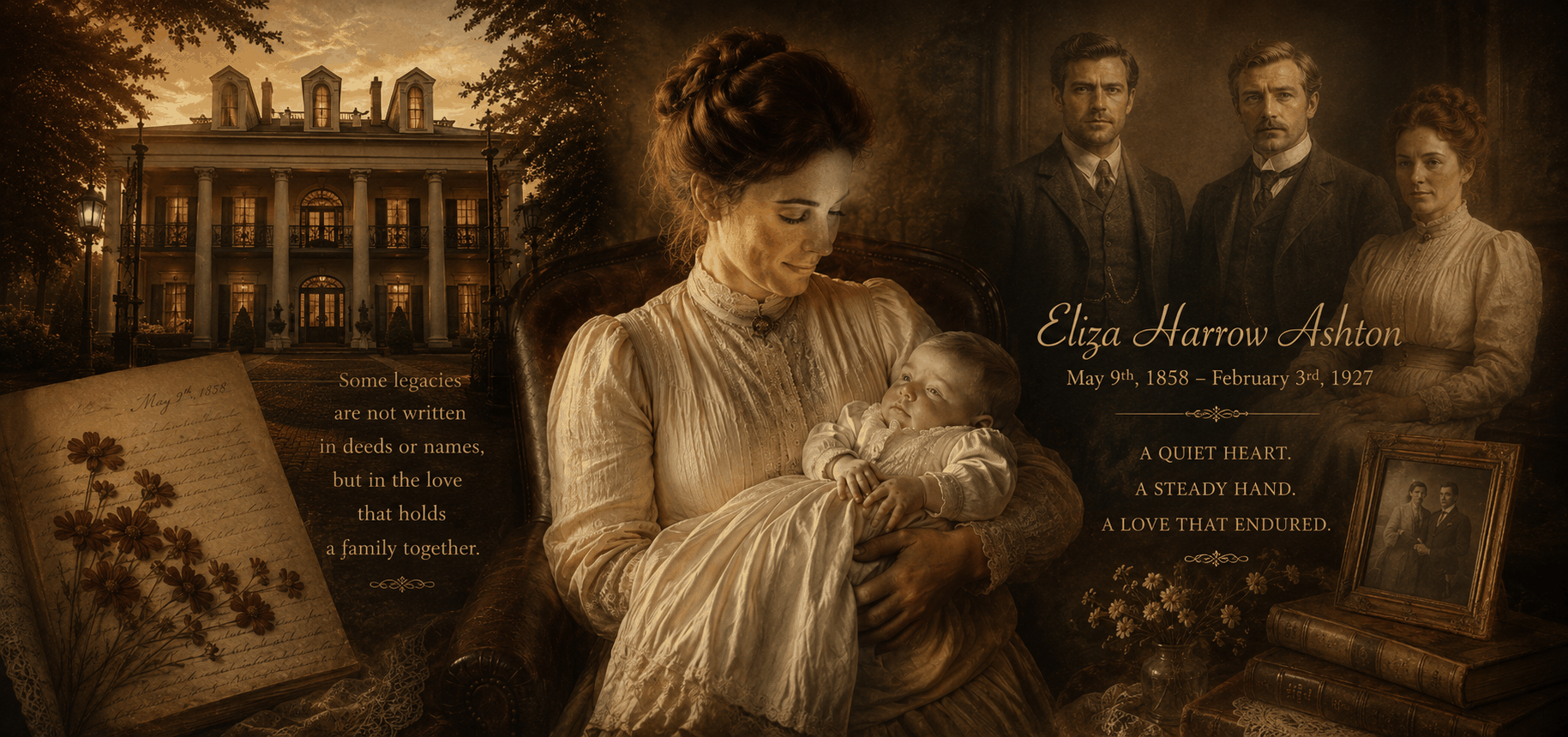
Eliza Harrow Ashton was a quiet and gentle woman whose life unfolded largely outside the public record of the Ashton family. Born in 1858, she entered a household dominated by powerful men, old obligations, and the long shadow of Clarence Ashton. In that world, Eliza was easy for others to underestimate. She did not command rooms, manage estates, or leave behind public decisions, but her strength showed itself in steadiness, patience, and the warmth she preserved inside a family often shaped by control.
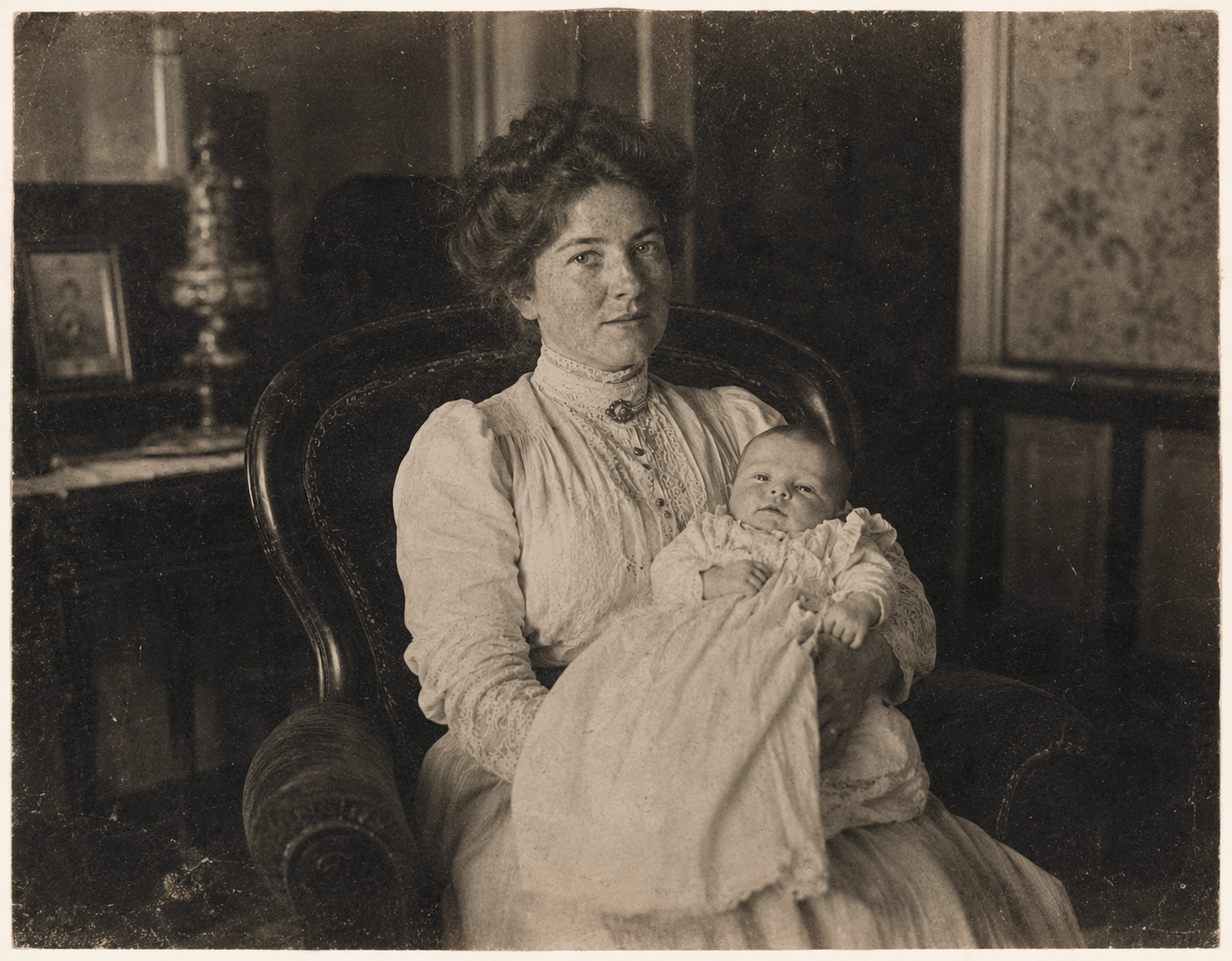
Remembered for her dark auburn hair, hazel eyes, and freckles across her cheeks, Eliza brought softness into the Ashton Residence without being weak. Her role as wife and mother was not ornamental. She held together the private life of the household in ways that were rarely acknowledged by the men whose names dominated its history. Her love for Ward, born late in her life after years of uncertainty, gave him one of the few sources of tenderness in an otherwise burdened inheritance.
Eliza’s legacy is quiet because the world around her made it quiet. She was not written into the family story with the force given to Clarence, Edmund, or Ward, yet her presence shaped them all. In the Ashton family, where property, duty, and legacy often mattered more than feeling, Eliza represented something more fragile and more enduring: the love that made a house feel like home, even when history tried to remember only the men who owned it.
Early Life
Eliza Harrow Ashton was born in Lawrence, Kansas, in 1858, into a family shaped early by uncertainty and unrest. The Harrows left Kansas for California first to escape the violence and instability that marked the region, and later in pursuit of the gold that had drawn so many families west. Like many who followed that promise, they found little gold waiting for them. What they found instead was work.
The family eventually settled in Briarmont, where Elias Hartwell’s growing timber operation had begun to transform the town. The work was hard, the industry destructive, and the future of the settlement increasingly tied to Hartwell’s ambitions. Eliza came of age in that environment, watching Briarmont build itself around timber while also beginning to understand the cost of what was being taken from the land.
Eliza did not meet Edmund Ashton until they were both adults. Their first connection came through town life, during a public meeting concerning the damage caused by Hartwell’s industry. Their courtship grew quietly from there, becoming a sincere and lasting love rather than an arrangement of advantage. Their wedding was modest, as Clarence Ashton had little interest in spending his wealth on a younger brother he had never truly valued. Even so, those who remembered it described the day as beautiful: small, heartfelt, and shaped more by devotion than display.
Education
Briarmont Common School
1866–1871
Received her early education after the Harrow family settled in Briarmont. Instruction would have included reading, writing, arithmetic, scripture, geography, penmanship, and basic history.
St. Catherine’s Seminary for Young Ladies, San Francisco
1871–1874
Completed finishing school, an uncommon level of education for many women of her background. Her studies included literature, music, etiquette, household management, needlework, correspondence, moral instruction, and the social expectations of respectable womanhood.
Private Domestic and Musical Instruction
1874–1876
Continued informal instruction after returning to Briarmont, likely through private tutors, church connections, and family acquaintances. This included piano, formal letter writing, household accounts, hosting duties, and the practical management of a respectable home.
Connection to the Briarmont Yarrow League
Eliza Harrow Ashton was associated with the Briarmont Yarrow League during its early years, though she was not remembered as one of its louder public voices. By the time the League formed in 1910, Eliza was an established married woman with an education, a household, and a long-standing concern for Briarmont’s future. Its early focus on women’s civic participation, suffrage, mutual aid, and local responsibility would have aligned naturally with values she already held.
Her role in the League was quiet but meaningful. Eliza was more likely to support meetings, correspondence, charitable work, and private organizing than to stand at the front of a room. As an Ashton, her presence carried social weight, but it also required caution. She belonged to a family tied closely to Hartwell Timber’s legacy, and that made open criticism of the old industry delicate.
Even so, Eliza’s involvement gave her a place in Briarmont life beyond the walls of the Ashton Residence. Through the League, she participated in the kind of women’s civic labor that often went unnamed in public histories but helped shape the town’s conscience, memory, and care for its people.
Personality
Eliza Harrow Ashton was remembered as a shy, quiet, and soft-spoken woman. From girlhood, she disliked having attention drawn to her and often seemed most comfortable at the edge of a room rather than the center of it. Her manner was gentle and reserved, with a dainty composure that made her seem delicate to those who did not know her well.
This shyness was not emptiness or weakness. Eliza observed more than she said, and her quiet nature gave her a careful understanding of the people around her. She was polite, affectionate, and deeply considerate, but she rarely pushed herself forward or demanded to be heard. In public, she could appear nervous under scrutiny, especially among forceful personalities or in rooms where men dominated the conversation.
After Ward was born, Eliza became more openly protective. He was her precious son, born late in her life after years when motherhood may have seemed unlikely, and that made her devotion especially fierce. She did not become loud or commanding, but she grew steadier when Ward was involved. Her strength remained quiet, but it became harder to move aside.
Those closest to her knew that Eliza’s gentleness had endurance. She was not naturally suited to conflict, but she could be firm when protecting the people and home she loved. Her strength was private rather than dramatic: the kind found in patience, devotion, and the ability to preserve warmth in a family often shaped by silence and control.
Legacy
Eliza Harrow Ashton’s legacy is one of quiet strength, private devotion, and the often-unrecorded influence of women in Briarmont’s history. She did not leave behind a public career, a political office, or a grand institution bearing her name. Instead, her importance lived in the spaces official histories often overlooked: the household, the nursery, the correspondence table, the women’s meeting room, and the daily work of keeping tenderness alive in a family shaped by duty and control.
Her greatest legacy was the love and protection she gave to Ward Ashton. Born late in Eliza’s life, Ward was precious to her, and motherhood made her more openly protective than she had been as a shy young woman. Her gentleness gave Ward an early understanding of home that was not rooted only in property, inheritance, or obligation. In a family where men were often remembered for ownership and command, Eliza represented care, warmth, and emotional survival.
In later Ashton history, Eliza remained a quiet figure, but not an insignificant one. Her life reveals how much of a family’s true legacy can rest with those who are least recorded. She stands as a reminder that the Ashton story was not only shaped by the men who built houses, signed wills, and controlled estates, but also by the women who made those houses livable, loved the children born into them, and preserved humanity where history preferred silence.