
Amos Pike
 | |
| Amos Pike | |
| Born | 1832 |
|---|---|
| Died | Unknown |
| Pronunciation | AH-mosh Pike — /ˈɑːmɒʃ paɪk/ |
| Gender | Male |
| Circumstances of death | Unknown |
| Organization | Hartwell Timber Co. |
Overview
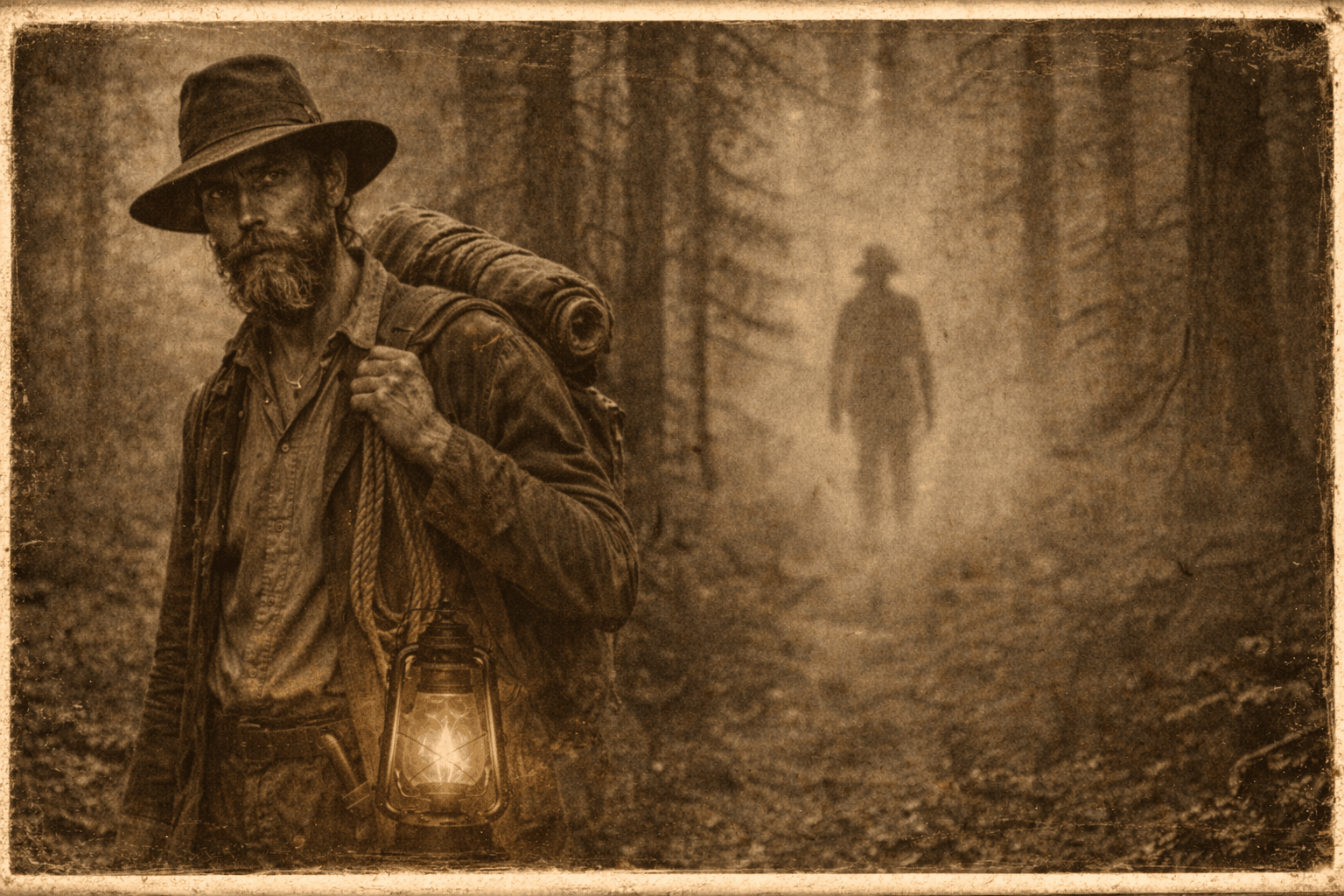
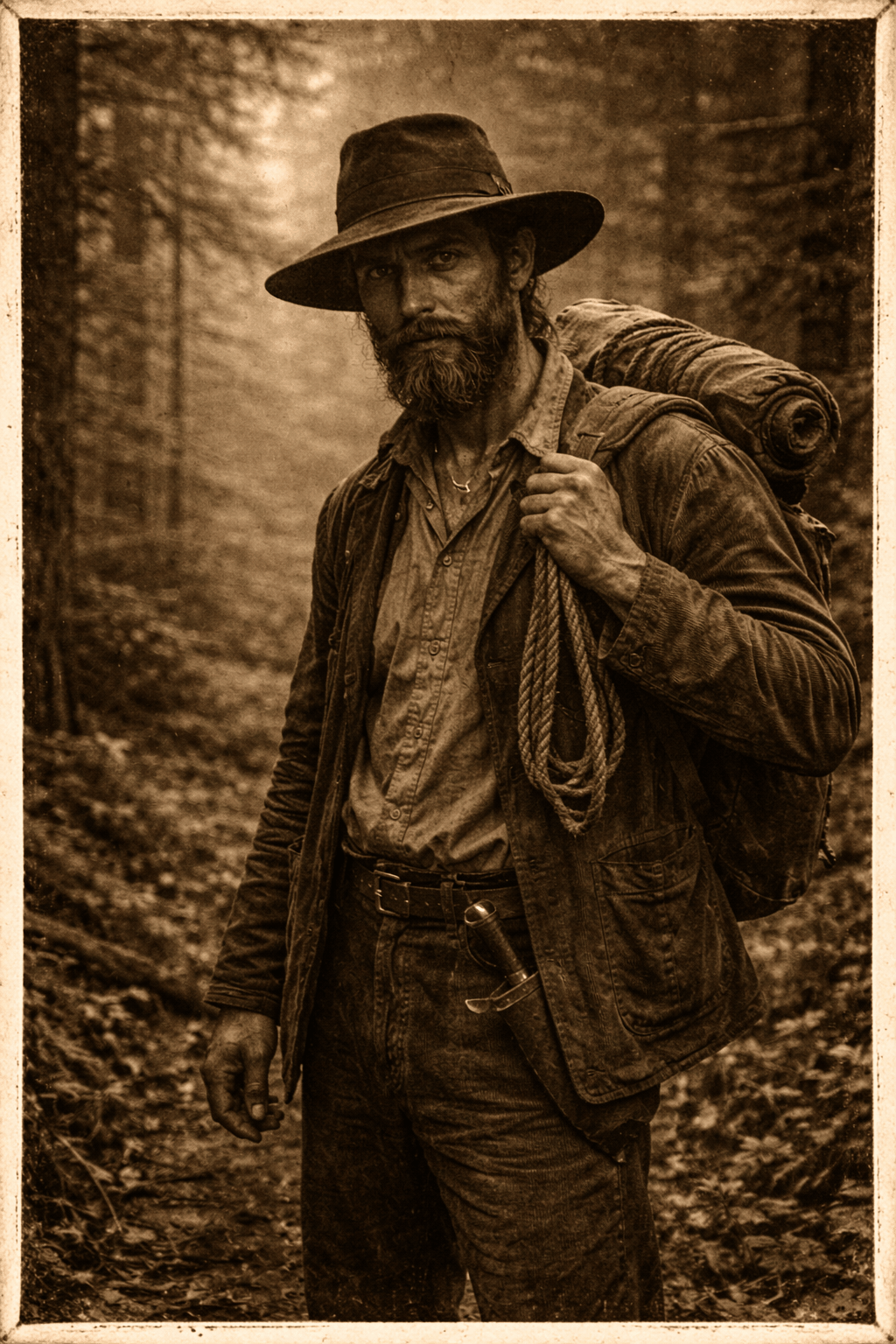
Amos Pike was one of the most elusive men ever employed by Hartwell Timber Co., working as part of its scouting and surveying efforts during the company’s early years. He was known for his unusual silence, his uncanny sense of direction, and his ability to move through the forest with so little warning that other men often failed to notice him until he was already beside them. Though he often worked alongside Nathaniel Vale, Amos inspired a different kind of memory. Nathaniel was remembered as a woodsman. Amos was remembered as something stranger.
In later years, Briarmont would give him another name: The Ghost of Briarmont.
Before Hartwell Timber Co.
Amos Pike came west from Pennsylvania Dutch country sometime before Elias Hartwell established his timber operations near Briarmont. He had been raised in a practical, disciplined world, one that valued labor, thrift, and self-sufficiency above display. Though later stories would paint him as mute, foreign, or somehow not quite ordinary, Amos was in fact a real man with a clear purpose. He worked because he wanted enough money to bring his own land into working order and live without depending too heavily on anyone else.
He was married, and he and his wife kept to themselves. Rather than settle in Briarmont proper, they made their home in a log cabin deep in the woods, well beyond the easier routes most townspeople used. Amos had no interest in bringing coworkers there, and no interest in explaining himself when silence was simpler.
That silence would later become one of the defining parts of his reputation.
Years Under Hartwell
When Hartwell Timber Co. began expanding into the forests around Briarmont, Amos Pike proved immediately useful. Hartwell’s crews needed more than cutters and haulers. They needed men who could move ahead of the work, read the land, and tell others where they could safely go. Amos became part of the company’s scouting and surveying teams, often working side by side with Nathaniel Vale.
He was exceptionally good at it.
Amos read ridge lines, creek beds, unstable slopes, game trails, and hidden paths with an ease that made other men uneasy. He always seemed to know where he was, even when there was no marked road to follow, and he moved so quietly through the woods that he earned a reputation for appearing out of nowhere. Some men believed he was mute. Others thought he must be foreign and simply unwilling or unable to answer them in English. Amos never bothered to correct either rumor. He spoke when he chose to, and rarely saw the point.
Despite his eerie reputation, Amos was not humorless. In camp, he developed a habit of playing small tricks on the other men, especially after difficult days in the forest. He would tap a shoulder from behind when someone thought himself alone. He would let cold water drip onto the back of a neck from some unseen perch above. Sometimes he would simply snap a twig in the nearby brush at exactly the wrong moment and enjoy the reaction from cover. In the harsher forest camps, where fatigue and bad weather could sour the mood for days, Amos’s tricks became a strange kind of relief. Men cursed him, laughed, and called him a ghost even while they looked over their shoulders for him.
That joke stayed with him.
Amos came to work, did his job better than most, and disappeared again into the woods at day’s end. He gave little away, and over time, that refusal to explain himself became as important to his legend as his actual skill.
Disappearance
One day, Amos Pike did not come to work.
At first, his absence caused less alarm than it might have for another man. Amos had always moved according to his own habits, arriving when expected but never in ways anyone quite understood. It was easy to assume some practical reason for his delay. But as the days passed, concern gave way to a more uncomfortable realization: no one truly knew where Amos lived.
He had never invited his coworkers home. He had never shown anyone the route he took into the woods. No one could say for certain which direction he went when the day’s work ended, or where to begin searching if they meant to find him.
One day became a week. A week became months.
Amos Pike never returned.
No public record survives of a body being found, and no clear account ever settled the matter. In the absence of explanation, rumors filled the gap. What began as an old camp joke hardened into legend.
Legacy and Folklore
In the years after his disappearance, Briarmont’s memory of Amos Pike changed. He stopped being merely an odd, gifted surveyor and became something more folkloric. The story passed down through campfire talk, family warnings, and town gossip until Amos Pike was no longer spoken of as a man who vanished, but as a presence that remained.
In modern Briarmont, the legend survives in several forms. To some, Amos Pike is a warning used to frighten young people away from wandering too far into the woods alone. To others, he is something closer to a guardian, a spirit of the forest who startles the reckless, terrifies those who come with bad intent, and guides the lost back toward safety before the wilderness can claim them. Stories persist of people hearing twigs snap in empty forest, or feeling cold water on the backs of their necks with no one in sight.
Whether anyone believes it is another matter.
But in Briarmont, Amos Pike is still remembered.