
Levi Boone
 | |
| Levi Boone | |
| Born | 1831 |
|---|---|
| Died | 1910 |
| Gender | Man |
| Organization | Hartwell Timber Co. |
Overview
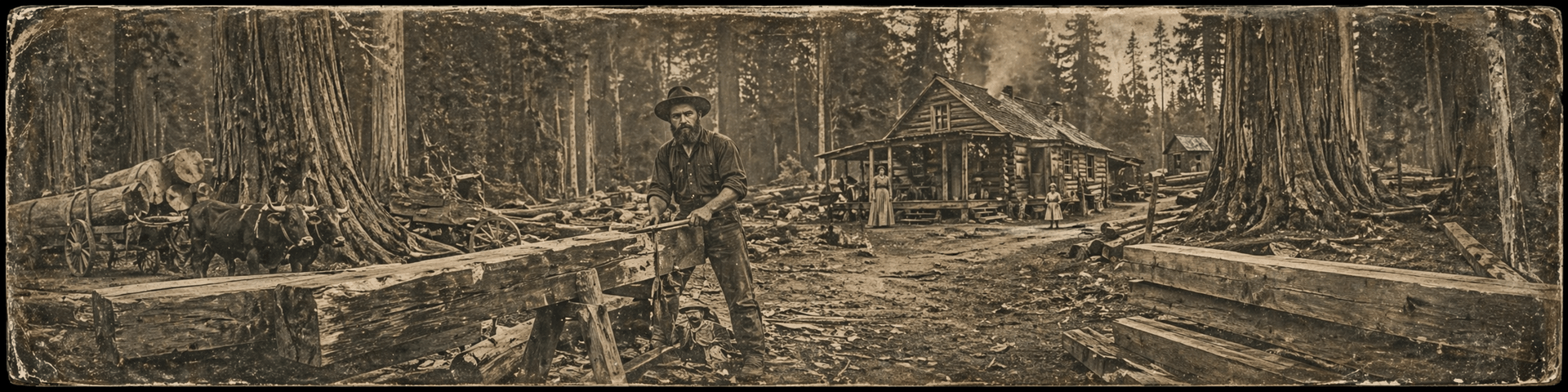
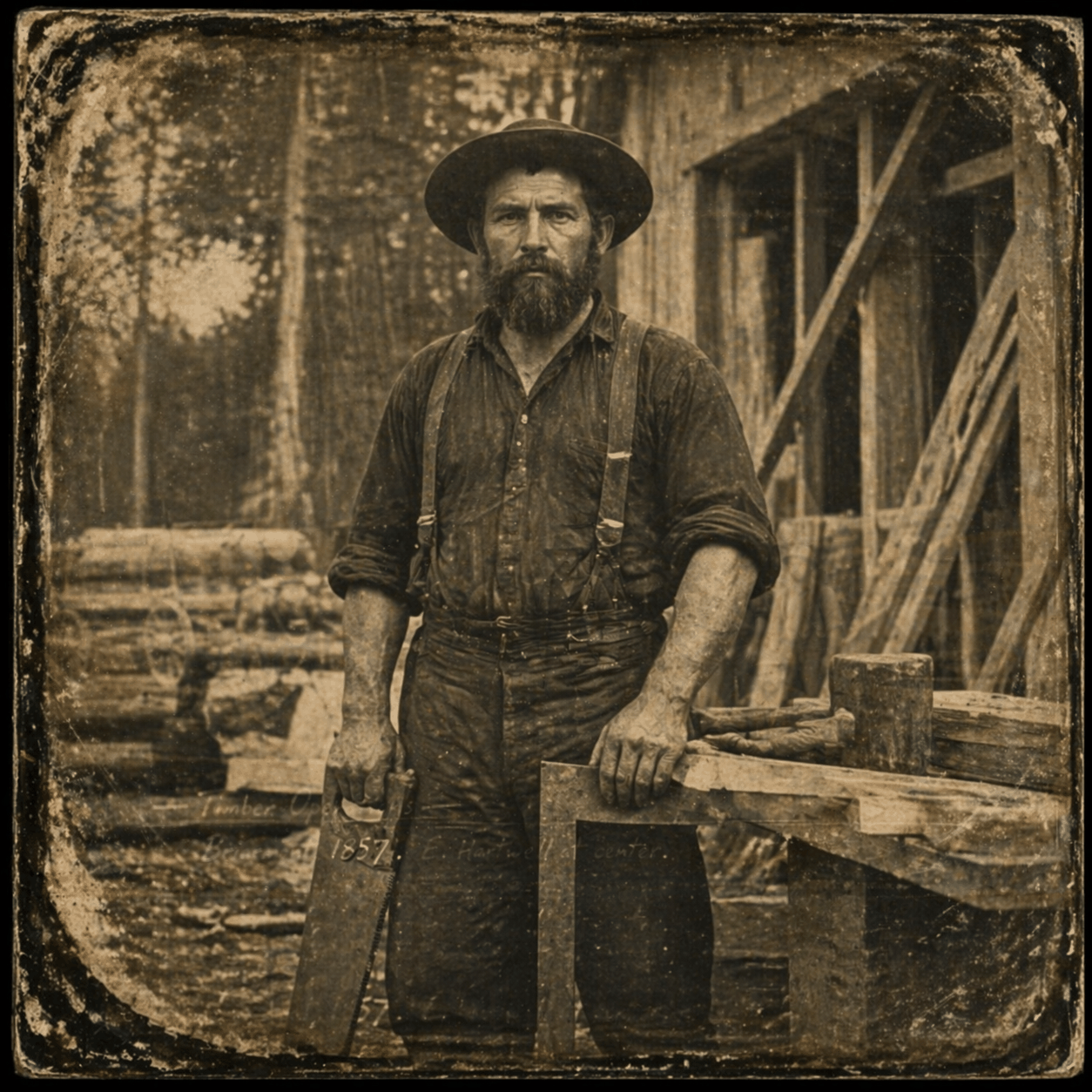
Levi Boone served as Hartwell Timber Co.’s camp carpenter and structural foreman, responsible for the rough-built infrastructure that allowed the company’s operations to function from season to season. While other men cut, hauled, surveyed, or hunted, Levi built what made that work possible: bunkhouses, sheds, platforms, braces, storage frames, work tables, wagon repairs, and the countless practical structures that separated a functioning camp from a disorderly one. In a company whose fortunes depended on speed and expansion, Levi represented a different kind of necessity: sound work, durable materials, and the discipline of making things hold. Gideon Rourke handled hauling, while Levi’s own place in the company was tied to construction and structural work.
He was not a romantic man and not an especially easy one. Levi was known for dry contempt, exacting standards, and a powerful dislike of waste, shoddy work, and hasty decisions dressed up as practicality. He did not hurry if hurrying meant rebuilding later. He did not flatter fools. He did not care much whether he was liked, provided that the beam was properly set, the frame square, and the roof pitched to survive the weather. Men who worked beside him often found him severe. Men who had to sleep under what he built learned to value the severity.
Unlike some of Hartwell’s other early men, Levi’s memory was not absorbed into a ghost story or a disappearance legend. He was remembered more plainly: as one of the builders of early Briarmont, as a stern but dependable family man, and as one of the few from the 1857 generation who lived long enough to become part of the town’s elder memory. Hartwell’s early operations helped give rise to Briarmont itself, and Levi was among the men who materially transformed that rough beginning into something more habitable and enduring.
He married, raised children in Briarmont, and died at a ripe old age. Long after his death, the Boone family eventually left town during the Second World War, drawn by work and opportunity in one of California’s larger cities. They did not return. What remained of them in Briarmont was not blood, but structure: things built, repaired, reinforced, and remembered.
Before Hartwell Timber Co.
Levi Boone likely came west with a trade already in his hands.
Whether born in the eastern United States or farther inland, he seems to have belonged to the class of men who did not drift west merely to gamble on luck, but to work. He would have apprenticed, formally or otherwise, in carpentry, timber framing, camp construction, or practical joinery. He was the sort of craftsman who understood not just how to cut wood, but how to use it properly: what kind of timber was fit for span, what could be trusted for weight-bearing joints, what warped, what rotted, and what failed when men got lazy.
That skill would have made him useful almost anywhere in the developing West, but especially in a rough frontier operation where buildings, repairs, and temporary structures constantly determined whether labor could continue at all.
Before Hartwell Timber Co. was fully established, Levi likely worked around smaller timber camps, wagon depots, or frontier settlements where practical carpentry mattered more than decorative refinement. He would have built in conditions where precision had to survive mud, shortage, weather, and men who always wanted the job done faster than the material allowed. That kind of life does not usually produce charm. It produces standards.
By the time Elias Hartwell began organizing his operations near Briarmont in 1857, Levi would have been exactly the kind of man worth keeping. Hartwell Timber began as an eight-man enterprise, and the company’s survival in those years depended not only on cutting timber but on establishing camps and structures that kept labor going in difficult country. Levi’s role in that small founding hierarchy makes sense for that reason.
He likely came into Hartwell’s employ not because of grand ambition, but because there was work enough for a carpenter who knew what he was doing, and because a growing timber operation constantly creates its own need for a man who can make order out of cut wood and rough plans.
Years Under Hartwell
Levi’s value to Hartwell Timber Co. was visible everywhere and named almost nowhere. The sort of work he did rarely drew glory, but everything around him depended on it.
He would have built and maintained camp frames, cook sheds, supply lean-tos, storage platforms, sleeping quarters, fencing, braces, mill-side improvements, repair benches, wagon components, and temporary crossings strong enough to bear both men and equipment. In the early years of the company, when Briarmont was still more camp than town, such work meant the difference between manageable hardship and total disorder. Hartwell Timber’s early expansion required not just extraction, but the material shaping of a working settlement. The company’s growth directly contributed to Briarmont’s formation as a township, and Levi’s craft would have been embedded in that development.
He was not a loud foreman. He did not need to be. Levi seems the sort of man who corrects with precision rather than spectacle. He could make a younger laborer feel incompetent with a glance at a crooked brace or a badly set post. He likely believed that most suffering in camp came from preventable causes: poor planning, poor measurements, poor material use, and men who mistook haste for efficiency.
That made him respected, but not always loved.
Where Gideon Rourke likely clashed with danger in motion, Levi dealt in failure that began long before anything collapsed. He knew what would sag, split, twist, leak, or buckle before other men admitted there was a problem. That kind of judgment made him essential in a company that too often rewarded speed more than soundness. Hartwell’s timber empire was built on aggressive expansion, and Levi’s own craft stood in quiet tension with that pace. Hartwell’s operations would later be remembered not only for their success but for the severe environmental damage they left behind, as hillsides eroded and waterways declined. Levi was not the sort to frame that in moral language, but he would have seen its effects in warped ground, unstable foundations, and structures forced to sit on land that no longer behaved the way it once had.
He probably worked closely with Gideon Rourke, whose hauling operations depended on strong platforms, repaired equipment, and camp structures that could withstand constant strain. He likely had practical dealings with Bernard Kessler as well, since carpentry and smithing meet naturally in frontier work. Amos Pike and Nathaniel Vale occupied stranger and more forest-bound roles in the company, and Levi probably regarded them with reserve rather than intimacy. Amos later became the center of Briarmont’s Ghost legend, while Nathaniel’s disappearance took on a darker mythological meaning in town memory. Levi, by contrast, remained in the older record as a man of tools, frames, and lived reality.
As the years passed, Levi did what builders of his type often do: he became more set in his ways, more precise, and less tolerant of nonsense. Men may have called him difficult. They likely slept better because he was.
Family Life
Levi Boone married during Briarmont’s early growth, likely once the settlement began to feel like something more lasting than a shifting timber camp. His wife was almost certainly a practical woman, the kind who could share a life with a man not especially gifted in softness. Levi was not the sort to perform affection openly, but he would have expressed commitment in the way many men of his type did: through work, steadiness, provision, and an almost stubborn dedication to keeping a household secure.
That distinction matters.
Levi was not a family man in the same warm, open way Edgar Briggs seems to have been remembered. He was a husband and father through structure. He built what the family lived in. He repaired what broke. He made sure the stove stood, the roof held, the porch stayed sound, and the walls did not let weather through. His children probably learned early that he was easier to trust than to approach, and easier to rely on than to read.
He and his wife raised children in Briarmont, most likely in a house Levi either built himself or had a heavy hand in constructing. That would have fit both his role and his temperament. A man like Levi does not easily separate work from home when his skill is literally what makes home possible.
As Briarmont expanded beyond its roughest beginnings, the Boone family became part of the town’s more stable, working backbone: not prominent in the grand manner of Hartwell, not folkloric like Amos or Nathaniel, but recognizably rooted. Levi’s children would have grown up in a place their father helped frame into existence. Whether they appreciated that fully while he lived is another matter.
The Boone line remained in Briarmont after Levi’s death. It lasted long enough for the family to become part of the town’s older fabric rather than a brief founding footnote. But their story in Briarmont did not last forever.
During the Second World War, long after Levi had died, the Boone family left the town for one of California’s larger cities. The move seems to have been tied not to scandal or rupture, but to practical necessity and opportunity. Levi’s son’s wife had a connection there, one that offered work for another Boone woman and helped stabilize the family at a time when wartime industry and urban employment were drawing people out of smaller communities across the country. The family relocated and, once gone, did not return.
That ending feels fitting for the Boones. They did not vanish in drama. They moved because history moved them.
Later Years and Death
Levi Boone lived long enough to become one of those men who seem to have always been old, even in middle age.
That, too, suits him. He was not reckless. He was not self-destructive. He did not burn bright and ruin himself in drink like Gideon Rourke, nor disappear into myth like Amos Pike, nor leave the world through mystery like Nathaniel Vale. His life appears to have followed a harsher but steadier course: hard work, hard standards, and enough care not to destroy himself for the amusement of anyone else.
As he aged, Levi likely became more rigid, drier, and more set in his habits. His hands would have stiffened. His back would have bent. His hearing may have worsened. But men like Levi often keep their eye longer than they keep their comfort, and one can easily imagine him as an older Briarmont figure still capable of judging bad workmanship at a glance and delivering a correction no one wanted, but everyone knew was deserved.
He would have lived long enough to see Briarmont become more settled than the camps of the 1850s and 1860s, and long enough to understand that many of the structures and habits of the place had outlasted the fever of its beginnings. Hartwell himself lived until 1911, when the company finally came apart under debt and decline. Levi likely died before the great later institutional transformation of the Hartwell estate into Oakridge in 1918, but not so early that he failed to witness Briarmont’s shift from raw extraction camp toward a more rooted town. Oakridge itself would eventually arise from the recognition that the land Hartwell damaged needed study, stewardship, and repair.
Levi died at a ripe old age, most likely in Briarmont, and likely in bed rather than in spectacle. That kind of death fits his whole life. He was not a man of flair. He was a man of endurance.
Legacy
Levi Boone’s legacy in Briarmont is quieter than that of some of the other men attached to Hartwell Timber Co., but in some ways more permanent.
Amos Pike survived in legend. Nathaniel Vale survived in mystery. Hartwell survived in records, estate, damage, and institutional consequences. Levi survived on boards, beams, framing logic, and town memory.
He became one of those names older residents or archivally minded locals would recognize even if modern Briarmont no longer had Boones living in it. His family line left during the Second World War and never returned, but the traces of Levi’s life remained in another form: in old structures, in inherited workmanship, in the memory that some of Briarmont’s earliest useful buildings were made by a man who preferred soundness to charm and durability to praise.
He was likely remembered differently depending on who spoke of him.
To some, he was simply difficult.
To others, he was dependable.
To younger men, he may have seemed humorless.
To older ones, he probably came to look wiser with time.
That is often the fate of men whose best quality is not charisma, but reliability.
If Briarmont remembers its legends by whisper, it remembers men like Levi Boone by standing inside what they left behind and forgetting, for a moment, that someone had to know how to make it stand at all.