
The Ghost of Briarmont
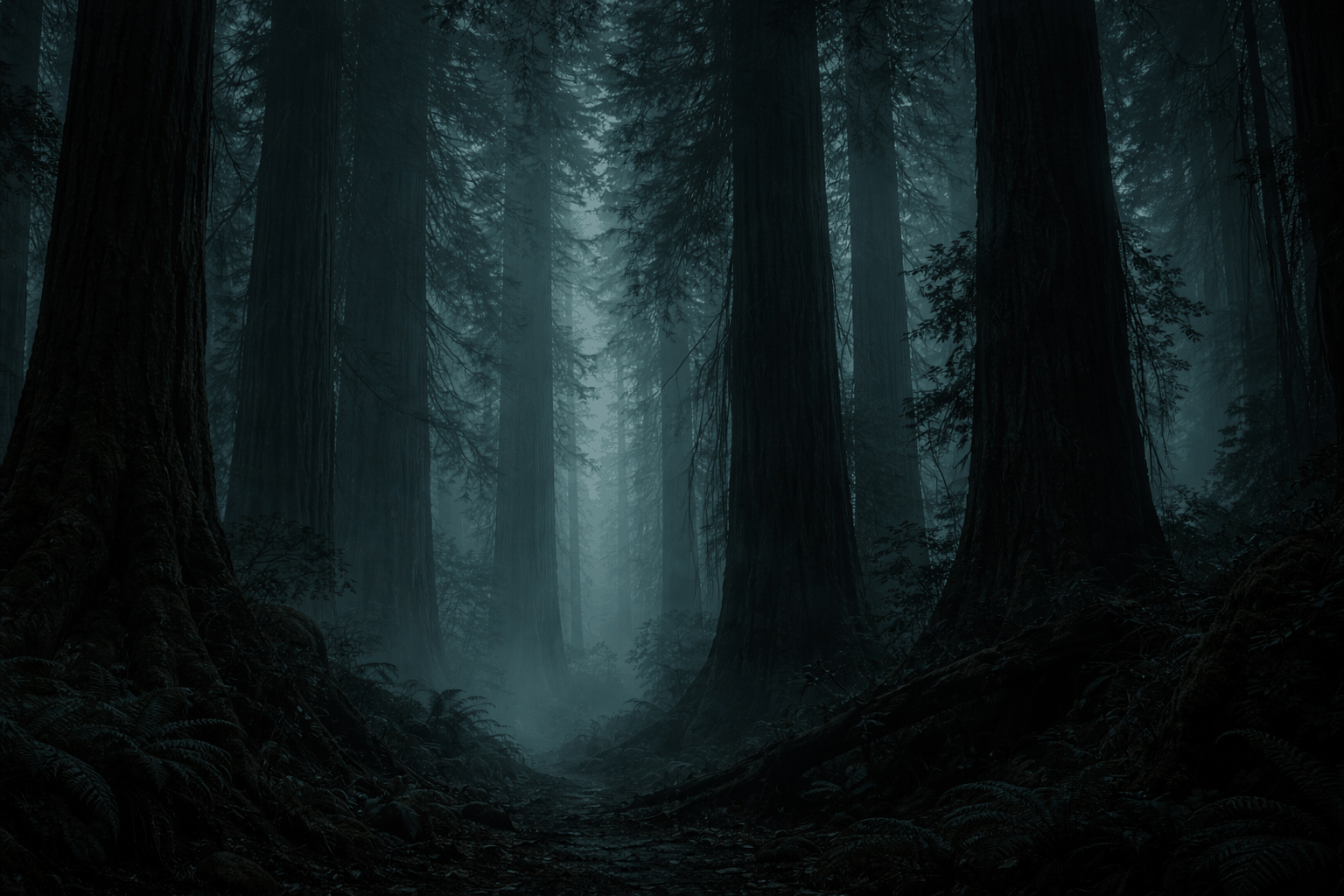
There are stories in Briarmont that are told for amusement, and stories told for warning, and stories told only when the fire has burned low and no one wishes to be the first to admit discomfort. Among these, none has endured so stubbornly, nor attached itself so thoroughly to the forests above town, as the legend of the thing once called simply the Ghost of Briarmont.
Old records, where they survive at all, speak of a man named Amos Pike, a surveyor and woods-runner employed in the early years of Hartwell Timber Co., when the forests still pressed close and dark upon the crude roads and half-finished clearings of the settlement. Those who worked beside him remembered a man of uncommon silence and alarming subtlety of movement. He was said to appear where no man had been seen a moment before, to know the forest by some instinct deeper than trailcraft, and to move with such unnatural lightness through fern, branch, and needle that others, less composed, took to jesting that he was scarcely flesh at all.
The joke came first, as such things often do.
Men in the camps, made coarse by labor and sharpened by isolation, called him the Ghost long before he vanished. When the mood in camp soured, he would startle them for sport, laying a hand upon a shoulder from behind when no footstep had been heard, letting cold drops of water fall upon the back of a neck on a bright and windless day, or cracking a twig at precisely the moment when a weary mind had begun to imagine itself alone. It was said that he laughed at such moments, though so faintly that men disagreed whether it was laughter at all or merely the dry whisper of needles shifting high above.
Yet if the jest began in rough affection, it did not end there.
Amos Pike disappeared without witness, warning, or trace, in the same dark span of years that also swallowed Nathaniel Vale, his sometime companion in the Hartwell surveys and the only other man in the crews said to possess a comparable understanding of the deep woods. Predictably, the talk began almost at once. Some muttered that the two had harbored between them an attachment improper to decent mention, and that shame, exposure, or some quarrel of that secret life had driven one or both to ruin. Others, with equal confidence and no greater evidence, suggested jealousy, violence, or the silencing of a dispute no one had overheard because Amos Pike was never known to speak, not even, so far as any man could swear, to Nathaniel himself.
Those suspicions, if not entirely extinguished, were later obscured by Nathaniel Vale’s own deterioration. Before he vanished, there had been whispers that something in him had begun to fail: his judgment, his health, perhaps even his mind. Men who had once trusted him in the deep woods spoke afterward of distraction, feverish strangeness, and a look about him that suggested he had seen too much, or tarried too long in places where no man ought to linger alone. Because he was among the only men known to keep any habitual company with Amos Pike in the forest, there were those who wondered whether the Ghost of Briarmont, if ghost he was, had not at last impressed some part of his own silent derangement upon him.
The unease only worsened in later years, when other cases of mental wandering, physical decline, and unexplained disappearance were remembered in rough connection with the same period. Men spoke of a blight passing quietly through camps and boarding rooms, though they disagreed whether it was a sickness of the body, the mind, or something that entered by subtler means. Only much later did more earthly explanations begin to gather around those events, suggesting that a common affliction may have moved among the laboring men of the region after all. But by then the legend had already fastened itself too securely to the facts, and no belated explanation could wholly strip Nathaniel Vale’s madness of the shadow Amos Pike had left upon it.
As for murder, there were those who insisted upon it. Men always prefer a human hand to an empty mystery. But no proof was ever found, save for a single photograph attributed to Nathaniel himself, in which Amos appears as if by accident rather than intention, half-caught in the frame like something not wholly willing to be recorded. Only one other image is said to show him with any clarity. In some group photographs, so the old hands liked to say, the men left an empty place where Amos ought to have stood, either because he would not stand still long enough to be taken or because they found it amusing to preserve the joke. In others, the gap was there for no confessed reason at all.
After his disappearance, the stories changed.
What had once been a camp jest hardened into testimony. Lumbermen who laughed easily in daylight began, after dusk, to report certain experiences with a seriousness ill-suited to drink or bravado. Twigs would snap at the edge of sight in places where neither man nor beast could afterward be found. Cold water would strike the back of the neck on dry afternoons beneath clear skies. Some swore they heard, far off among the trunks, a thin breath of mirth that was not quite human laughter and not quite wind: a faint, needling exhalation like pine boughs combed by a hard current of air. Those who heard it rarely agreed upon the direction from which it came.
By then there were already some in Briarmont who preferred the simpler explanation: that Amos Pike had never been entirely a man in the first place. Or, if he had been, that the forest had made some claim upon him long before the town knew his name. Such notions are easy to dismiss in full daylight, from a porch or tavern bench, with the road and the church and the sound of other voices close at hand. They are not dismissed so lightly on the upper ridges, where the old growth still stands beyond the reach of Hartwell’s ambition, and where the shadows gather early even in summer.
Thus the legend persisted and multiplied.
To children, he became a warning. To restless youths, a dare. Those with more imagination than caution began venturing into the woods after dark to prove themselves immune to old wives’ tales, and some came back pale enough to lend fresh vigor to the old accounts. One would say he heard a footfall keeping pace with him just beyond the brush. Another swore that something touched his shoulder when no one stood behind him. A third, usually after some delay and with much insistence that he had not been frightened, described a sudden run of cold water down his back on a night without rain. The wiser among them did not go twice.
There are gentler forms of the story too, though they are less often told by boys trying to impress one another. In those versions, the Ghost of Briarmont does not merely frighten. He warns. He startles the arrogant and turns the cruel back toward the road. He lures the reckless away from ravines, bad ground, and the more treacherous parts of the mountain. He is said to hate loud men, greedy men, men who carve initials into old bark or take more from the forest than they have any right to carry home. The lost he misleads only long enough to humble them. The wicked he does not guide at all.
What Amos Pike was in truth remains uncertain, and perhaps must remain so if the legend is to keep its power. A silent surveyor who vanished. A hermit returned to the woods. A murdered man. A thing never fully human. A spirit born not from death but from the long memory of the forest itself. Briarmont, being Briarmont, has found room for all these explanations and discarded none of them.
Even now, there are those who say the old joke was only a joke, and those who smile too quickly when they say so. But no one who has spent enough time alone in the woods above town fails to understand why the story endured. In certain weather, under certain trees, with evening settling in and the path less certain than one had believed, it is not difficult to feel that one is being observed by something patient, amused, and very old in its silence.
And when the twig breaks behind you, it is a rare soul indeed who does not turn.