
The Vanishing of Nathaniel Vale
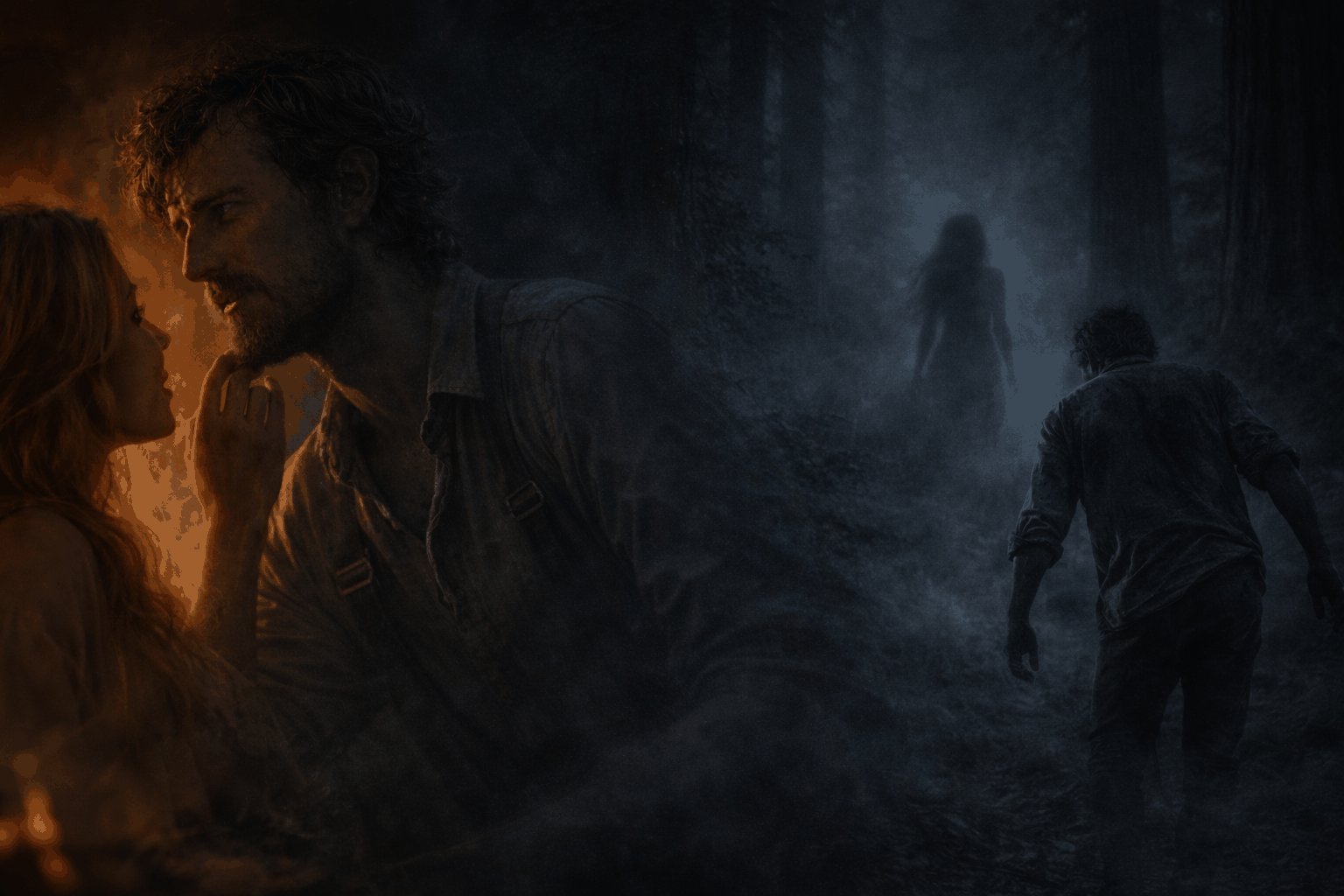
There are in Briarmont certain tales which the sober dismiss in daylight, yet repeat in lowered voices when dusk draws long among the trees. Of these, few are so often told, or told with such a curious mixture of pity and dread, as the vanishing of Nathaniel Vale, the woodsman who went into the forest and did not return.
In the old Hartwell years, when the camp roads were little more than mud ruts cut into the land, and the redwoods stood close and immense about the clearings, Nathaniel Vale was counted among the most dependable men in the company. He knew the ridgelines, the gullies, the game trails, and the hidden temper of the woods as some men know the arrangement of rooms in their own houses. There were places in that country where he could walk by instinct and places where others, even armed and provisioned, would not willingly linger after sunset. He was not, by all accounts, a man much given to fear.
He was also remembered, by those who cared to remember such things, as a handsome man.
That detail survives in the old talk more often than one might expect. Nathaniel was said to have possessed the easy, dangerous charm of certain men who do not seem, even in rough company, wholly bent by labor. Women in Briarmont noticed him. Men noticed that women noticed him. He had, so the older phrasing went, a way with the ladies, and though this was repeated sometimes with admiration and sometimes with contempt, it attached itself to his story so firmly that later generations found it impossible to disentangle the man from the rumor.
It is perhaps for that very reason that his end took so deep a hold upon the local imagination.
For Nathaniel was also one of the only men known to work with any regular closeness beside Amos Pike, that singular scout and surveyor whom the camps had already taken to calling The Ghost of Briarmont. Amos moved through the forest in so strange and noiseless a fashion that the name clung to him almost of its own accord. He was seen where no one had heard him approach. He appeared at a shoulder as though stepped out of bark and shadow. He delighted, in the rough fashion of lonely camps, in unsettling tired men with a hand from nowhere, a broken twig in the gloom, a cold drop of water down the spine on a dry day. What had begun as jest, however, began over time to gather the heavier color of superstition.
And Nathaniel, more than most, was said to have gone longest and deepest into the woods with him.
The old men who spoke of it afterward could never agree on when precisely the change in Nathaniel began. Some insisted it came on gradually, over weeks or months, and was too subtle at first to invite alarm. Others swore that one could mark the beginning to a particular season when the fog lay low, and the camps were damp with a kind of clinging misery that rotted tempers and left the strongest men uneasy in their own beds. But all agreed that in the last stretch before he vanished, there had been something not wholly right in him.
He grew distracted.
A man would speak to him, and Nathaniel would not answer at once, but stand as though listening to some other voice pitched below the hearing of ordinary ears. He was seen pausing at the edge of camp with the air of one half-decided whether he had been called. He took wrong turnings in places he should have known blindfolded. Men who had trusted him in dark weather and bad ground began to say, though only when he was out of earshot, that Nathaniel no longer looked at the forest in the old way. It was no longer only the land he watched. It was as if he expected the land to answer.
There were, too, the things he said.
At first, they were mutterings no one cared to examine closely. Then, as his condition worsened, they became harder to dismiss. One man swore that Nathaniel, staring into the black margin beyond the fire, whispered, “She is out there again.” Another claimed he heard him murmur, with an expression more rapt than frightened, “Do you not hear her? She calls softer than water.” There was a night, told of with especial unease, when Nathaniel was said to have turned suddenly toward the trees and spoken as though answering someone no one else could see: “No, not yet. Not where they can hear.”
Others remembered worse.
One heard him say, “She walks where the light will not follow.”
Another, after long reluctance and more drink than honesty, insisted that Nathaniel once caught him by the sleeve and whispered, “If she touches your neck, do not turn. Whatever you hear, do not turn.”
And there was one man, a saw hand not especially prone to inventions, who swore that on the final evening Nathaniel stood very still beside the tents and said, with terrible tenderness, “She has my name in her mouth.”
Because Nathaniel had long been admired by women, and because men of rough camps rarely surrender a human scandal in favor of a supernatural one when they can keep both, a second explanation grew alongside the first. Some said his undoing must have begun with a woman: a jealous one, a scorned one, or one wronged in some way no gentleman would later admit. The more vulgar among the camps preferred this version, for it allowed them to put a familiar face to ruin. Yet as the story aged and soured into folklore, that woman ceased in some tellings to be entirely mortal. She became instead something older and less knowable — a presence in the forest, female only because Nathaniel had named her so, or because the woods themselves had chosen to take on a form he would follow.
Thus, the two rumors entwined.
On one side stood Amos Pike, silent and unnatural, The Ghost of Briarmont, whose company Nathaniel had kept too long and too closely. On the other stood the half-glimpsed woman of Nathaniel’s mutterings, whether spirit, temptation, hallucination, or curse. Some said the Ghost had driven him mad. Others said a forest-bride had called him. Others, less imaginative but no less afraid, concluded that both explanations might in some obscure way be the same.
Then came the night itself.
In the versions most often told, it was a night of low firelight and uneasy conversation, the kind that settles over lumber camps after a bad day and too much drink. The men had gathered where they always did, near the great communal blaze, eating what could be cooked, muttering over old grievances, and listening to the woods in spite of themselves. Beyond the ring of orange light stood the tents, dark-backed and slick with dew, and beyond them the immense trunks of the redwoods, rising into a blackness so high the eye could not follow them.
Someone noticed Nathaniel standing apart.
He had come without his hat, without his jacket, dressed only in his work shirt as though he had risen from his bedroll in confusion or stepped away from the fire in a trance. Some said he was swaying as he stood. Some said he seemed to be listening. Some said he was already past speaking to. There are accounts which claim a man called after him and received no answer. There are others which insist that no one dared to speak, for the expression on Nathaniel’s face was so altered, so emptied and intent at once, that even those half-drunk on bravado felt unwilling to break whatever communion had seized him.
It was then, according to one of the darker versions, that Nathaniel smiled.
Not broadly, not like a man greeting a friend, but faintly and with the distracted softness of one who sees something beloved at a great distance. Then he said — and this is among the most repeated lines in the whole affair — “There you are.”
To whom this was spoken, no one could say.
He began to walk.
Not with purpose, and not like a man who knows where he is going, but with that dreadful, uneven gait by which the mind advertises its own disturbance: tilted, uncertain, one shoulder low, the feet finding the earth as though by accident rather than command. He passed between the tents and toward the deeper trees, and the fire behind him cast such a strange, partial light upon his figure that the men who watched later disagreed whether he was moving away from the camp or being drawn from it.
One man said he saw, for only a second, another shape pacing him between the trunks to the right.
Another swore that just before Nathaniel crossed beyond the outermost veil of light, there came the sound of a twig snapping where no one stood.
Another, who lived long enough to become tiresome with repetition, claimed that he heard then a thin and breathless noise like laughter, except that it was not laughter as men know it, but rather the dry whisper of pine needles driven together by a hard wind aloft.
And one, a man too frightened to embellish elegantly, swore he heard Nathaniel say once more, very softly, “I’m coming.”
At first, no one followed.
This failure has been explained a dozen ways: that they thought Nathaniel meant to relieve himself and would return; that they were drunker than later conscience permitted them to confess; that the woods beyond camp were at night never entered lightly; that something in the scene itself imposed a paralysis upon them. Whatever the reason, those first moments passed. When at last several men gathered their nerve and lanterns and ventured after him, the forest had already resumed its ancient indifference.
They found no Nathaniel Vale.
There are stories of tracks that ended too abruptly. Stories of disturbed fern and then nothing. Stories of a shirt sleeve caught on bark and then discovered, when brought close to the light, not to be cloth at all but some torn rag no one could afterward identify. One man insisted they followed the sound of footfalls for several minutes only to discover, with a horror no drink could wash out, that they had been listening to their own frightened company echoed back to them from the trunks. Another returned from the search pale and shaking, and would say only that he had heard someone walking behind him on the needles all the way back to camp, matching his pace precisely, though every time he turned, there was only darkness and the smell of wet earth.
By morning, no trace remained that could satisfy the practical mind.
Thus was Nathaniel lost, and thus did rumor take up what fact had dropped.
Some said the forest had claimed him in punishment for going too far, too often, into places men had no right to name. Some said Amos Pike, whatever he had become after vanishing, had returned for the only companion he had ever tolerated. Some said Nathaniel had been lured away by the very feminine spirit he seemed, in his final days, to hear calling from the trees: a jealous thing, perhaps, or a lonely one, or one that had taken offense at his attentions elsewhere and meant to keep at last what Briarmont had borrowed. Yet even those explanations, harsh and fanciful though they sound, failed to quiet the darker tale. For why should such madness come upon him when it did, if not from too close a nearness to the thing the camps had called the Ghost?
In later years, when other strange illnesses and disappearances from that era were remembered in confused connection, a few sensible men attempted to impose upon the old stories a more material order. They spoke of camp blights, bad blood, fevers of the mind, and miseries that traveled quietly through rough towns and rougher quarters. These explanations pleased almost no one. They were too bloodless for the frightened, too incomplete for the skeptical, and in any case arrived too late to unmake a legend already rooted in the town’s imagination.
For Briarmont never truly lost Nathaniel Vale.
His story remains tangled with Amos Pike’s in every telling. Boys dare each other to walk the old camp lines after dark and call Nathaniel’s name aloud, just to see whether the forest answers. Hikers who stray too deep into the redwoods and come back pale will sometimes swear they saw a man ahead of them in shirtsleeves, stumbling as if dazed, always just beyond the next stand of trees, never close enough to catch. Others speak of hearing two sets of footfalls where only one man walked, or of glimpsing a figure pass between the trunks with another shadow moving beside it, thinner and quieter still. And there are still stories — told most often by women who heard them from grandmothers who heard them from camp wives — that if a man goes into the woods vain of face and careless of promise, some soft voice may call him by name from beyond the last of the tents.
And if he answers, he is seldom seen again.
Whether Nathaniel Vale was taken by Amos Pike, by madness, by memory, by a woman wronged, by a woman imagined, or by the long and watchful spirit of the forest itself, Briarmont has never quite decided.
It is enough, perhaps, that the redwoods keep their own counsel.