
Edgar Briggs
 | |
| Edgar Briggs | |
| Spouse | (his first wife, name unrecorded) Sara Mae Briggs |
|---|---|
| Children | Holt Briggs seven elder children (names unrecorded) |
| Gender | Male |
| Organization | Hartwell Timber Co. |
Overview
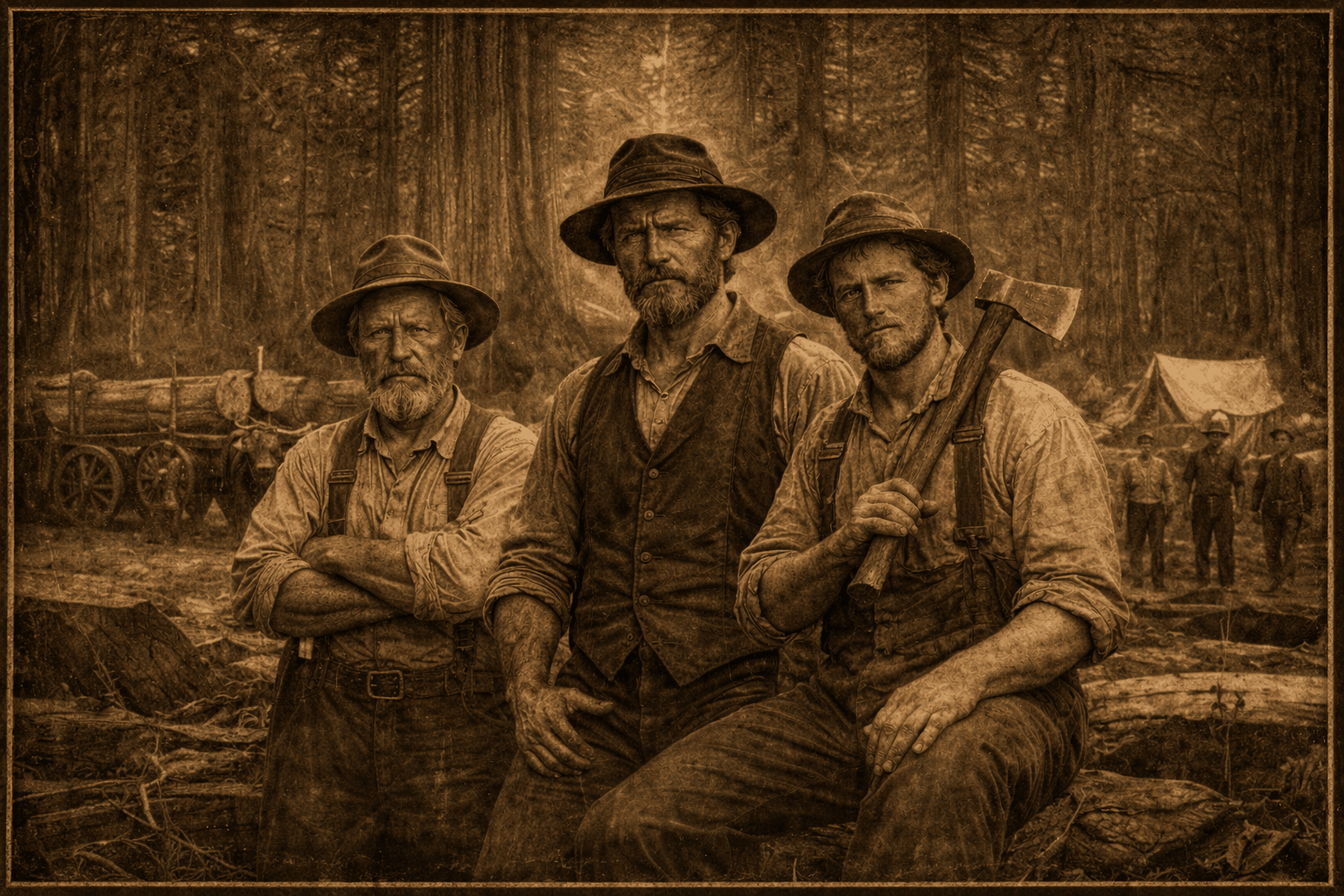
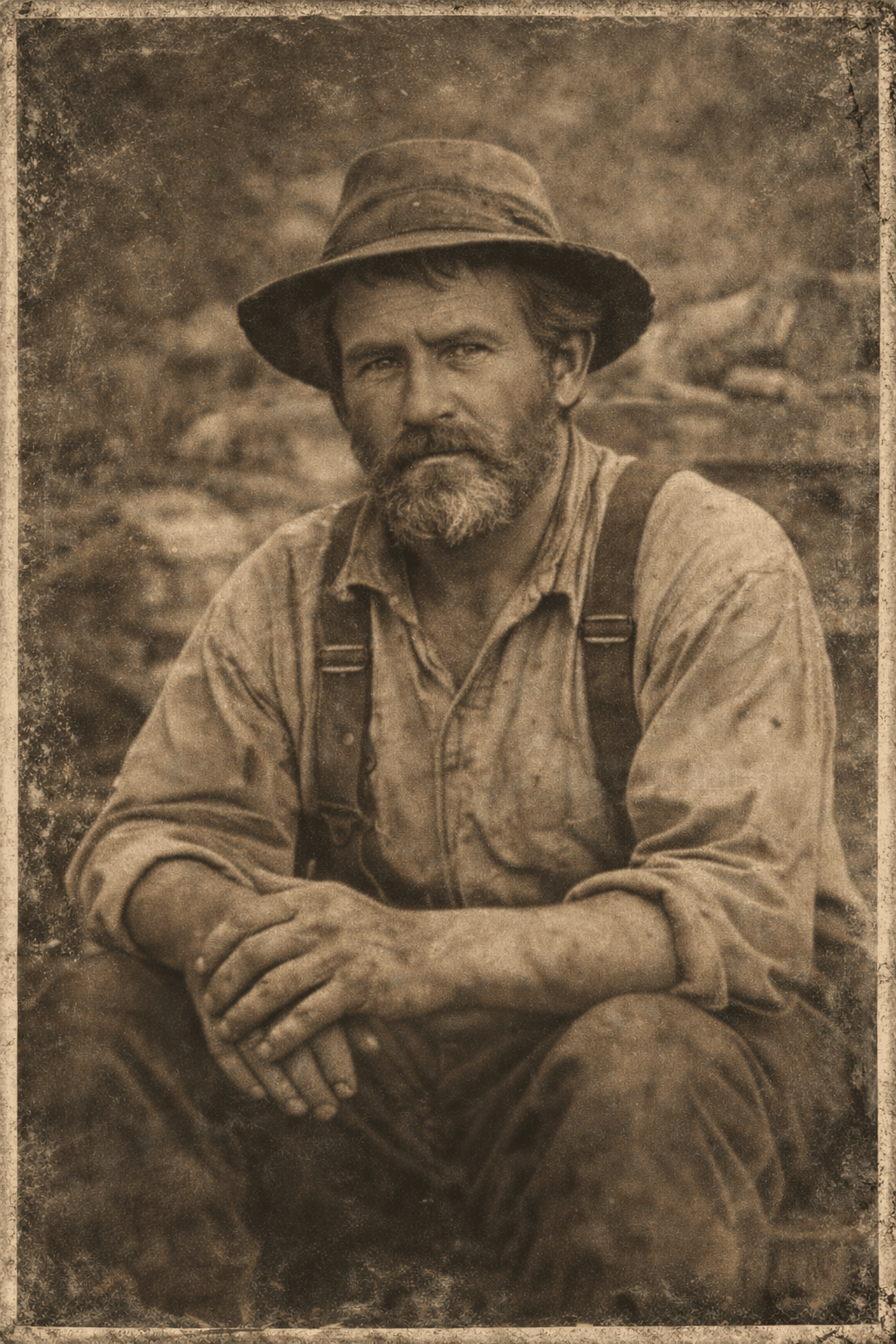
Edgar Briggs was one of the early men of Hartwell Timber Co., first employed as a saw hand and camp medic before eventually rising to become foreman of the sawmill. Practical, steady, and deeply rooted in family life, Edgar represented a different kind of frontier success than Elias Hartwell. He did not build an empire. He built a home, a trade, and a life that endured. By the time his youngest son, Holt Briggs, was born in 1899, Edgar had become one of the most established working men in Briarmont, respected not for ambition or wealth, but for reliability, skill, and sheer staying power.
Early Life
Edgar Briggs was born around 1837 in Virginia. He came of age in a world where opportunity was often spoken of more easily than it was found, and like many young men of his generation, he looked west when he began to imagine a better life for himself. At twenty, newly married and unwilling to spend the rest of his years scratching out the same uncertain future he had inherited, Edgar left Virginia with his wife and headed for California in search of gold.
He found some.
Not enough to become rich, and not enough to join the ranks of the men whose names outlived them, but enough to give him something more useful than legend. With what he earned, Edgar secured a measure of stability. He put money toward a modest but permanent home, purchased basic sawing equipment, and began trying to build a living in timber rather than gambling everything on the uncertainty of the goldfields.
His wife, Sarah Mae Briggs, was the anchor of that life. Where Edgar brought practical skill and persistence, Sarah brought endurance, order, and the kind of domestic steadiness without which frontier households often fell apart. Their marriage proved lasting, and together they built one of the larger working families in Briarmont, eventually raising eight children, with Holt Briggs born as the youngest in 1889.
Joining Hartwell Timber Co.
By the time Elias Hartwell began consolidating control over the timber trade around Briarmont, Edgar Briggs had already shown enough skill to be noticed. He knew his way around saws, tools, and timber processing, and had also picked up enough rough medical knowledge to be useful in camps where proper doctors were scarce, and injury was an ordinary part of daily life.
Hartwell hired Edgar for two reasons. The first was practical: Edgar’s experience as a saw hand and his ability to patch up injured men made him unusually valuable in a growing operation. The second was strategic. Hartwell had little patience for independent competition and preferred to absorb useful men into his own enterprise rather than leave them room to become rivals. Bringing Edgar into Hartwell Timber Co. served both purposes at once.
In the company’s earlier years, Edgar worked as both saw hand and camp medic. He handled hard mill labor when needed, helped keep cutting operations moving, and stitched, splinted, cleaned, or steadied whatever bodies came back from the woods damaged enough to need attention but not dead enough to bury. In a place like early Briarmont, where formal medicine lagged behind danger, that made him indispensable.
Years Under Hartwell
Edgar was never one of Hartwell’s visionaries, nor one of the men who gave speeches or shaped public memory. He was something more durable than that. He was the sort of man operations leaned on without always properly admitting it. When saws jammed, belts slipped, men got hurt, tempers flared, or output had to be maintained despite exhaustion and bad weather, Edgar was the one people looked for.
Over the years, he became known as a worker of uncommon steadiness. He was not flashy, not particularly romantic, and not interested in playing at grandeur. He believed in doing a thing properly, in keeping tools fit for use, and in finishing the work in front of him without complaint unless complaint would actually improve the outcome. Men trusted him because he was competent, and because he did not dramatize what frontier life already made difficult enough.
As the timber company expanded through the 1860s and 1870s, Edgar’s place within it became more secure. He married labor with responsibility, and responsibility with longevity. Unlike some of the younger men who vanished into drink, violence, misfortune, or the wilderness itself, Edgar endured. He outlasted camps, bad seasons, injuries, and the shifting fortunes of Hartwell’s enterprise.
By 1889, the ten years before his youngest son, Holt Briggs, was born, Edgar had risen to the position of foreman of the sawmill. It was a role that suited him perfectly. By then, he was no longer simply another hand among many, but a man responsible for order, output, maintenance, and discipline within one of the most important parts of Hartwell Timber Co.’s operation. If Hartwell’s company fed on ambition, then the sawmill survived on routine, and routine was where Edgar Briggs excelled.
Family Life
For all his years in and around Hartwell Timber Co., Edgar’s real pride was never the company. It was his family.
He and Sarah Mae Briggs raised eight children in Briarmont, building a household known for its noise, order, and stubborn resilience. Edgar was by all accounts a committed husband and father, not especially sentimental in manner but deeply loyal in practice. He worked long, came home tired, and still made himself part of the life waiting there. His children knew him as a hard man, but not a cruel one. He expected work to be done, respect to be shown, and foolishness to be kept within tolerable limits, but he was also the sort of father whose steadiness made a home feel secure.
By the time Holt was born in 1899, Edgar was already an older father, established enough that his youngest son entered a very different household than the one his older siblings had known. Holt grew up not in the uncertainty of his parents’ earliest frontier years, but in the shadow of a father who had already earned respect, stability, and a lasting place in Briarmont.
Later Years and Death
Edgar remained tied to the sawmill and to Briarmont for the rest of his working life. He lived long enough to watch Hartwell Timber Co. change from a raw frontier operation into an aging institution struggling beneath the weight of its own history. He saw prosperity, decline, and the gradual hardening of the town around the industry that had made it.
Unlike Hartwell, whose legacy would become tangled with ambition, damage, and civic consequence, Edgar’s memory remained more local and more human. He was remembered as a capable foreman, a reliable set of hands, a man who knew how to keep both saws and people from failing before their time. He was also remembered as one of the rare men of that early era who managed to build a full life without being devoured by it.
Edgar Briggs died at the age of eighty-three, at home and surrounded by family. It was, by the standards of Briarmont’s early history, an unusually gentle end.