
The Bellamy - Humbolt Disappearances
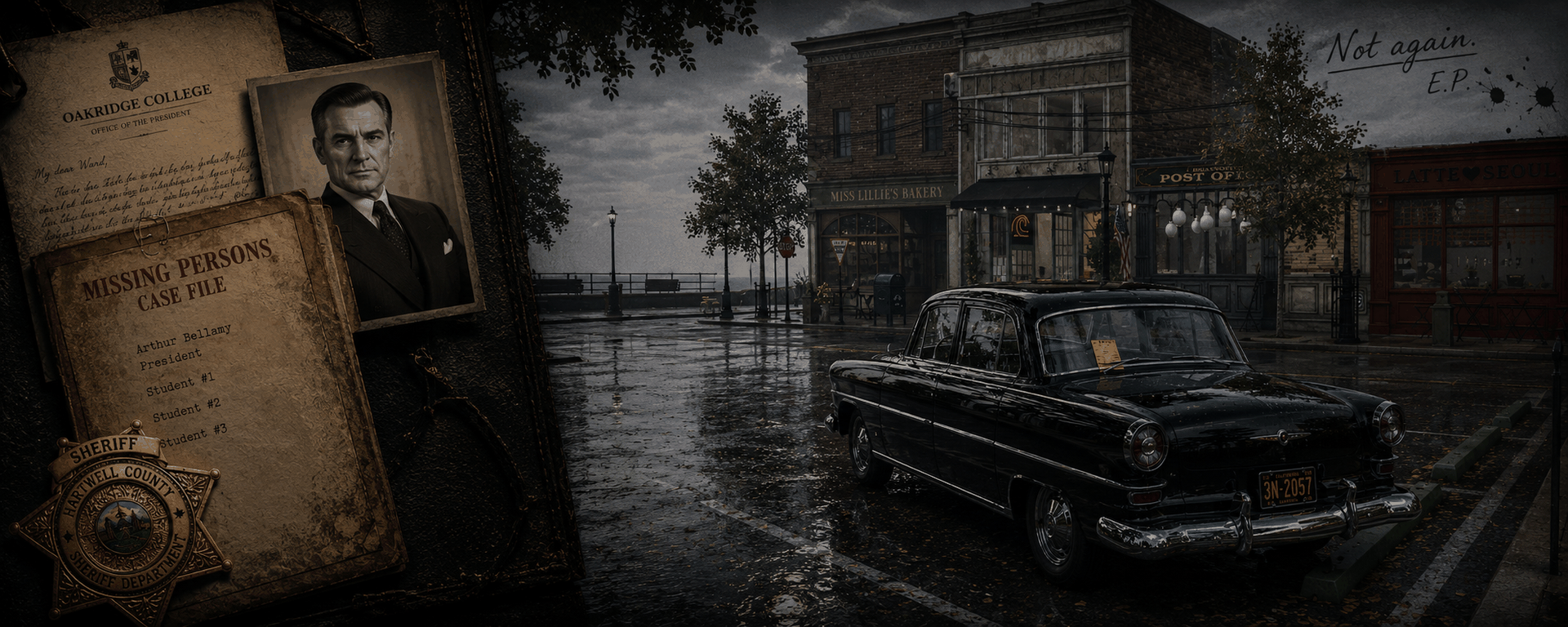
The Bellamy-Humbolt Disappearance
Sheriff Harold “Hal” Humbolt was outside the Hartwell County Sheriff’s Department smoking a cigarette when the telephone rang inside. It was a little after ten in the morning, and Briarmont had not yet decided what kind of day it meant to be. A gray marine layer still hung over the trees, thin enough to promise sun later but stubborn enough to keep the street damp and quiet. Humbolt stood beneath the shallow overhang near the office door, hat pushed back, one shoulder against the wall, the cigarette held between two fingers stained faintly yellow from years of the habit.
He had wanted to smoke at his desk. That would have been simpler: coffee, case notes, ashtray, chair. But the ashtray in his office was already full, and not all of it was his. Deputies had a way of treating the Sheriff’s ashtray as county property when they came in to talk. Emptying it would mean admitting he had noticed, and Humbolt was in no mood to perform housework for men old enough to carry sidearms. So he smoked outside, listening to the distant hiss of tires on damp road and the quiet morning business of a county that had not yet found trouble.
The phone rang again. Humbolt looked through the glass toward the front office. No one picked up. With a low curse, he took one last pull from the cigarette, dropped it beneath his boot, and crushed it against the concrete before stepping inside. The receiver was still ringing when he reached the desk.
“Sheriff’s Department. Humbolt.”
For a moment, there was only breath on the line. Then a woman said, “Sheriff?”
He knew the voice before she gave her name. Mrs. Bellamy had the careful tone of a woman raised to stay composed even when composure had become a form of suffering.
“This is Margaret Bellamy. Arthur hasn’t come home.”
Humbolt glanced toward the clock on the wall. Ten in the morning. Arthur Bellamy was many things: President of Oakridge College, trustee favorite, public speaker, polished dinner guest, and a man who understood the value of appearing necessary. He was not, by reputation, careless with his household. If his wife was calling the Sheriff’s Department at ten in the morning to say he had not come home, she had already spent the night waiting.
“What time was he expected?” Humbolt asked.
“Yesterday evening. By six. Usually earlier. He leaves Oakridge around four or five, depending on the day.”
“Did he call?”
“No.”
“Could he have stayed late?”
There was a pause. Not long, but long enough.
“He does sometimes. But not without saying so. Not lately.”
Humbolt reached for the cigarette pack in his shirt pocket out of habit, then remembered he was inside and let his hand fall. “Any reason he’d be delayed?”
“I called the college this morning. They said he left the grounds yesterday afternoon.”
“Who said that?”
“His office. Miss Rourke. She sounded...” Mrs. Bellamy hesitated. “She sounded uncertain.”
Humbolt took a pencil from the cup beside the phone and pulled a notepad closer. “Stay by the phone. If he comes home, call me directly. If anyone calls about him, you write down every word before you answer any questions. Understand?”
“Yes.”
“I’m going to Oakridge.”
“Sheriff?”
He waited.
“My husband is not a spontaneous man.”
“No, ma’am,” Humbolt said. “I know.”
He hung up and sat for three seconds longer than he needed to. Then he reached for his hat.
Oakridge looked peaceful by late morning. That was one of its tricks. The old Hartwell estate had been softened by lawns, stone paths, new buildings, and academic language, but Humbolt had lived in Briarmont long enough to remember what the land had been before men began calling it stewardship. Oakridge liked to present itself as clean, ordered, and forward-facing. Beneath it lay Hartwell money, Hartwell timber, and Hartwell scars.
Students crossed the paths in twos and threes, carrying books, speaking too loudly, and pretending youth had made them immune to history. Humbolt parked outside the administration building and stepped from the car. Miss Rourke was waiting inside Bellamy’s office suite, standing behind her desk with her hands clasped so tightly that the knuckles had gone pale. She was a tidy woman in her thirties, with a sharp part in her hair and a stricter one in her conscience. Humbolt had questioned enough secretaries to know they were often better witnesses than the men they served. They saw what passed through doors. They knew which meetings went on calendars and which did not.
“Miss Rourke,” Humbolt said. “Mrs. Bellamy tells me the President left campus.”
“Yes.”
“What time?”
“Around four. Perhaps a few minutes after.”
“Alone?”
She looked toward Bellamy’s closed office door. Humbolt waited. He had learned that silence could loosen a careful witness more effectively than a raised voice.
“No,” she said at last. “He was with three students.”
“Names.”
“I don’t know if I should—”
“Miss Rourke.”
The word was quiet. It did what shouting would have ruined. She opened a drawer and removed a sheet of paper.
“I believe these are the students. They had been in and out of his office that afternoon. There was no formal appointment.”
Humbolt took the page, folded it once, and put it in his pocket. “Where did they go?”
“For a walk.”
“A walk.”
“That is what President Bellamy said.”
“In the forest?”
“Yes. The west trail, I think. Or toward it. It did not seem unusual at the time.”
Humbolt looked at the office door again. “The President of Oakridge took three students walking in the woods at four o’clock in the afternoon and did not say why.”
Miss Rourke’s lips pressed together. “Sheriff, faculty, and administrators walk with students often. The grounds are part of the college. There are trails. Botanical areas. Old survey markers. It is not improper.”
“I didn’t say improper.”
“You sounded as if you meant it.”
“I sound that way most days.”
That almost broke the tension, but not quite. He asked to see Bellamy’s office.
It was exactly as he expected and not at all what he wanted. The desk was orderly, the papers stacked, the fountain pen aligned. There was no overturned chair, no scattered books, no note left where a man might leave one if he knew he was stepping into danger. The room smelled of expensive single malt whiskey, old wood, and the kind of money that became respectable once someone called it a donation.
On the wall, a framed photograph showed Bellamy with trustees. The President stood slightly forward of the others without seeming to. He had the gift of centrality. Some men stepped into a room and occupied the space. Bellamy made the room rearrange itself.
“What was his mood?” Humbolt asked.
“Preoccupied.”
“Angry?”
“No.”
“Afraid?”
Miss Rourke did not answer immediately. Humbolt turned from the desk and looked at her until she did.
“I would not say afraid.”
“What would you say?”
She lowered her voice, though there was no one else in the room. “I would say he was resolved.”
That word stayed with Humbolt. Resolved was not casual. Resolved did not go for a walk.
“Did he say when he would return?”
“No.”
“Did the students seem upset?”
“No. Quiet, perhaps. But not upset.”
“Did anyone else know where they were going?”
“I don’t know.”
“That’s not the same as no.”
“No,” she said. “It isn’t.”
By then, the campus had begun to feel too clean. Humbolt took the west trail before noon, following the likely route from the administration building toward the forest edge. It was a decent path, used by students, faculty, and courting couples who thought deputies did not know what courting couples did where the trees grew thick. The trail wound past underbrush and old markers, then bent toward deeper woods where the maintained grounds gave way to Briarmont’s older body.
There were footprints, but there were always footprints. The ground was too used near campus and too confusing beyond it. He found nothing that said Bellamy had struggled, nothing that said three students had run, and nothing that said anyone had intended not to return. That bothered him more than signs of violence would have. Violence had grammar. Panic had punctuation. A clean trail was just a sentence cut off before the verb.
By early afternoon, he had deputies making calls. By midafternoon, he had men checking student rooms, family homes, local roads, and the edges of the college grounds. The matter moved from concern to investigation, though no one at Oakridge wished to hear the word spoken plainly. The college wanted caution. Humbolt wanted facts. The two were not natural allies.
Then he found the car.
It was sitting in Crenshaw Square in front of the church. It was not hidden, not abandoned off a logging road, not burned, and not shoved into brush. It was parked in the plain civic heart of Briarmont, beneath church windows, near storefronts, under the indifferent gaze of people who had walked past it for hours. A parking ticket sat tucked beneath the windshield wiper.
Humbolt stood in front of the car with his thumbs hooked in his belt and stared at the ticket until the square around him seemed to quiet. That was what bothered him. Not the car itself. Not at first.
In that part of Briarmont, Crenshaw Square was the only place a man could park without leaving his vehicle on private property, and Bellamy was a man of habits. He drove into town most mornings, left the car there through the working day, and went on to Oakridge. Between four and five in the afternoon, he came back, got in, and drove home.
On the rare nights when Bellamy stayed late at Oakridge, he moved the car. Everyone who worked close enough to his office seemed to know he was careful about that. Bellamy disliked disorder. He disliked small embarrassments even more. A parking ticket was beneath him, which meant the ticket was not beneath the case.
Humbolt pulled it from beneath the wiper and read the time. Then he read it again. A small thing. Ink on paper. A clerk’s duty. A nuisance to most men. To Humbolt, it was the first honest witness.
The town had seen the car. The town had ticketed the car. The town had not noticed the missing man. That was Briarmont all over, he thought. A place could look a thing dead in the face and still decide it was none of its business.
He circled the car once. The doors were locked. No broken glass. No blood. No sign of a struggle. Nothing obvious on the seats. Nothing was thrown aside in panic. Bellamy had either stepped away from the car, expecting to return, or someone had made sure the car would say exactly that.
A clean scene was not the same as an innocent one.
Humbolt glanced toward the church doors, then toward the storefronts facing the square. From there, a person could watch the car without seeming to watch it. A man waiting for Bellamy could stand with a newspaper, smoke a cigarette, speak to a clerk, or sit in a parked truck and look like part of the furniture of town life. That was the danger of routines. They made men legible.
Bellamy’s routine would not have been secret, but it did not need to be. His staff might have known it. His family did. The church staff may have noticed. Nearby shopkeepers, deputies, town clerks, students cutting through the square, and anyone with patience enough to watch for a week could have known when the President of Oakridge was within reach.
Humbolt folded the ticket and put it in his breast pocket. “Who wrote you?” he muttered to the car.
The car, like most witnesses in Briarmont, answered by remaining exactly where it was.
By evening, the square had begun to talk, and by the following morning, it had begun to lie. One woman was certain she had seen Bellamy near the church steps at quarter past four. A shopkeeper swore the car had already been parked there at three. A boy delivering parcels said he saw three students walking toward the square, though he could not say if they were Oakridge students or merely looked like they ought to be. A retired mill hand told Humbolt he had heard voices near the church after sundown, low and hurried, but admitted he had been drinking. Humbolt wrote all of it down. He trusted statements the way he trusted old bridges: enough to cross, never enough to stop testing the boards beneath him.
The car changed the whole shape of the thing. Bellamy had not simply walked into the forest from Oakridge and vanished. His car was still in town, where it always was, only wrong by the measure of time. If Bellamy had walked with the students at four, would he have returned to the square? Had they? Had someone met them? Had he intended to move the car and been stopped before he could? Or had the walk been nothing but the first step in a route someone else had planned?
At first, the theory of a simple woodland accident still held its place. People wanted it to. Accidents were tragic, but they did not require the county to look at itself too closely. That made them useful. A fall, a wrong turn, a student prank gone bad, a private errand misjudged by respectable men; any of those would have allowed the college, the county, and the families to grieve without asking who had reason to keep four people from coming back.
Then the older stories returned.
Briarmont had never been free of disappearances. Long before Bellamy, Humbolt, and Oakridge’s postwar respectability, the forests had carried other names. In the Hartwell years, men connected to the timber camps, land routes, and company work had gone missing under circumstances that were rarely documented cleanly. Some were written off as accidents. Some were folded into labor disputes, drunken misadventure, animal attacks, or the hazards of frontier work. Others became stories families told quietly when official answers proved too thin.
The Ghost of Briarmont was the most famous of these old tales. By 1959, many residents treated the ghost as folklore, a leftover from the Hartwell Timber era and the stories surrounding Amos Pike. The tale belonged to older Briarmont: lantern light in the trees, strange sounds near old routes, men vanishing where the forest grew thick, and the uneasy belief that Hartwell’s extraction years had left more than stumps and silted creeks behind.
Humbolt did not believe in ghosts. He believed in patterns, and Briarmont had too many of them. Old stories, like old roads, had a way of surviving beneath whatever people built over them. If men had vanished from these woods before, the useful question was not whether a ghost had taken them. It was whether someone had learned how easily the forest could be blamed.
The more he looked at Bellamy’s disappearance, the more the case seemed to point in two directions at once. One trail led toward the forest, old work roads, abandoned timber sites, and places where the trees grew over the county’s first sins. The other led toward offices: Oakridge trustees, county supervisors, court men, clerks, donors, and rivals who smiled too quickly when asked simple questions.
Marshal Hallifax Tooms smiled too quickly. He was a narrow man with polished shoes and a habit of standing with his hands behind his back, as if always waiting for someone to paint him into a courthouse portrait. His authority ran close enough to the Sheriff’s Department to be useful and separate enough to be irritating. Court protection, process, old jurisdictional habits, ceremonial pride. Tooms treated all of it like sacred inheritance.
He received Humbolt in his office without offering coffee.
“I understand this has become difficult for your department,” Tooms said.
Humbolt sat without being invited. “My department still has its Sheriff.”
“For now.”
The words were soft. Too soft to accuse. Too clear to ignore. Humbolt studied him. Tooms did not blink.
“Bellamy ever come to you?”
“President Bellamy moved in many circles.”
“That ain’t an answer.”
“It is the only responsible one.”
Humbolt leaned back. “You court boys do love responsible answers.”
Tooms smiled again. “And you field men do love mistaking mud for evidence.”
There it was. The old rivalry in its Sunday clothes. Humbolt left with nothing he could write in a report and plenty he could feel in his teeth.
Constable Joshua Lightfoot was different. Broader, warmer, more local in his manner, and therefore harder to read. He had a politician’s memory for names and a preacher’s patience for silence. Where Tooms made authority look polished, Lightfoot made it look neighborly. That bothered Humbolt more.
Lightfoot met him outside the courthouse and lit a cigarette with a silver lighter.
“Hal,” he said. “You look like hell.”
“Working a case.”
“So I hear.”
“You hear anything useful?”
Lightfoot exhaled smoke toward the street. “I hear the college is scared. I hear the Board is scared. I hear Tooms is enjoying himself, which means everyone else ought to be careful.”
“You hear anything about Bellamy?”
“I hear he had enemies.”
“Names.”
Lightfoot smiled sadly. “A man like Bellamy collects enemies the way a pine collects needles. You don’t count them one by one. You look at the ground beneath him.”
It was a good line. Too good. Humbolt disliked good lines during investigations. They were often rehearsed.
“Where were you the evening he vanished?”
Lightfoot’s smile did not move, but something behind it cooled. “Careful, Sheriff.”
“I’m always careful.”
“No,” Lightfoot said. “You’re honest. That’s not the same thing.”
Humbolt looked at the cigarette between Lightfoot’s fingers, then at the courthouse behind him. “Is that a warning?”
“It’s a kindness.”
“Those get men killed, too.”
Lightfoot dropped the cigarette, crushed it beneath his shoe, and walked away.
By the end of the first week, the investigation had divided itself into factions whether Humbolt wanted it to or not. The college wanted discretion. The Board wanted reassurance. The newspapers wanted names. The families wanted the truth, though no two families seemed to be getting the same amount of information. Tooms wanted jurisdiction respected. Lightfoot wanted everyone to remember he was helpful. Deputies wanted orders they could follow without feeling the ground shift under them. Humbolt wanted one clean fact that did not evaporate under pressure.
He went back to Crenshaw Square again and again. He stood where Bellamy’s car had been parked. He watched the church doors. He timed the walk to the nearest side street. He noted which windows faced the square. He asked who had issued the ticket, who had seen the car before the ticket, who had seen it after, who knew Bellamy’s usual hour, who knew when he stayed late, and who had reason to know when a careful man would fail to move his vehicle.
The ticket clerk cried during the second interview.
“I thought it was just a car,” she said.
Humbolt softened then. He could be hard, but he was not cruel without purpose.
“It was,” he said. “Until it wasn’t.”
The forests waited beyond town. They always did.
Search parties found scraps, rumors, old bottles, animal tracks, rusted wire, a collapsed hunting blind, and a length of cloth that proved to have nothing to do with the case. They found places where men had camped recently and places where men had not stood in years. They found old timber cuts choked with new growth. They found black stumps from fires no one remembered reporting. They found silence thick enough to make good men talk too loudly. They did not find Bellamy. They did not find the students.
At night, Humbolt sat in his office with the door closed, a cigarette burning between his fingers, and read through old case files. He pulled records from the Hartwell years, older than him, older than his father, some copied so poorly the ink looked like bruises. Missing laborers. A woodsman gone. A company man was last seen near a creek. A rumor of a lantern. A report dismissed as drunkenness. A name crossed out. A witness recanting. A body was never found.
In the margins of one old file, some long-dead deputy had written only two words: Not again.
Humbolt stared at those words for a long time.
The next morning, he asked for the Bellamy student files again. Oakridge delayed. That afternoon, Tooms visited the Sheriff’s office. He did not remove his hat.
“I’ve heard you’re requesting college records beyond the reasonable scope of the disappearance.”
Humbolt leaned against his desk. “You hearing that as Marshal or as somebody’s errand boy?”
Tooms’ face hardened. “You are not the only authority in this county.”
“No,” Humbolt said. “But I’m the one with missing people.”
“And if you mishandle this, you may also be the one who damages the college, the county, and every office connected to this investigation.”
Humbolt stepped closer. He was not a tall man in the way Bellamy had been tall, but he knew how to occupy space. The Marines had taught him that. So had Briarmont.
“Funny thing,” he said. “People only start talking about damage when they know where the fire is.”
Tooms left without another word.
An hour later, Lightfoot called and asked if Humbolt wanted advice.
“No,” Humbolt said.
“You need it.”
“I need names.”
“Names are expensive right now.”
That sat between them over the line.
“Who’s buying?” Humbolt asked.
Lightfoot sighed. “Hal, listen to me. There are men in this county who can survive a scandal. There are institutions that can survive a scandal. But people? Families? Students? Deputies? We don’t always survive what powerful men call clarification.”
“Is Bellamy dead?”
Silence.
“Joshua.”
“I don’t know.”
“Do you know who does?”
The line crackled. “I know,” Lightfoot said carefully, “that the forest is a convenient place for the county to put things it does not want to file.”
Then he hung up.
That night, Humbolt did not go home. By then, the case had become something that lived with him. It sat in the passenger seat of his patrol car. It stood behind him when he shaved. It waited at the bottom of every coffee cup. Bellamy’s car. The ticket. The students with no public names. Tooms’ smile. Lightfoot’s warning. Old files. Old ghosts. Old Hartwell dirt under new Oakridge stone.
Near midnight, he took a flashlight, a sidearm, a pack of cigarettes, and drove toward the north woods. He told one deputy he was checking a lead. He did not say whose.
The road narrowed beyond the last houses. Pavement gave way to gravel, then dirt. The trees leaned in close, redwoods and firs rising like the columns of a church no one had consecrated. Moonlight caught in the upper branches but did not reach the ground. The forest took the beam of his headlights and broke it into pieces.
Humbolt parked near an old service road connected to a former timber route. The place was not on most maps anymore, but he knew it. His father had known it. Men in Briarmont knew roads the county pretended it had forgotten.
He stepped out into the cold air and listened. The forest made its ordinary sounds first: insects, needles shifting, distant water, something small moving under brush. Then it made no sound at all. That was when he felt it, not fear exactly, but recognition, as if the trees had been waiting for him to arrive at the proper conclusion.
He took the flashlight and followed the old road inward. Mud sucked faintly at his boots. His beam moved over trunks, roots, stones, black fern, and old cable half-buried in moss. Once, the light caught a rusted spike in a stump and made it shine like a wet eye.
He thought of Bellamy walking here in polished shoes and could not make the image fit. He thought of three students following him and liked it even less.
A branch snapped somewhere ahead. Humbolt stopped and called out, “Sheriff’s Department.”
The words went into the trees and came back smaller. He waited, one hand near his holster, the other tightening around the flashlight. Nothing moved. Then, far off to his left, he saw a light: small, amber, low to the ground. A lantern, his mind supplied, though that was foolish. No one carried lanterns anymore unless they wanted to look like a story.
The light vanished, and Humbolt moved toward it.
The old files came back to him as he walked. Men vanishing in Hartwell’s time. Lanterns between trees. Amos Pike becoming less a man than a warning. Nathaniel Vale swallowed by rumor and undergrowth. Company roads that led nowhere useful unless someone wanted them to. He had dismissed those stories all his life because a Sheriff who believed in ghosts was no good to anyone. But the forest did not require belief. It only required entry.
His flashlight flickered. He slapped it once with his palm. The beam steadied, then thinned.
“Not now,” he muttered.
The trees ahead opened into a narrow clearing, not large, and not natural either. The ground bore old scars beneath the moss, faint lines where something had once been dragged or hauled or built. Humbolt stepped into the clearing and saw, at the far edge, something pale caught in the roots.
Paper.
He crouched as the flashlight dimmed again. The paper was damp, folded, and stuck beneath a stone. Not old. Not from the Hartwell years. He reached for it.
Behind him, someone breathed.
Humbolt turned fast, drawing the light and his sidearm together. The beam caught nothing but trunks.
“Show yourself.”
His voice was steady. He would have been proud of that later, though there was no later for him to remember it.
The flashlight flickered harder now. Its beam pulsed against the trees, turning branches into arms, knots into faces, empty spaces into doorways. In one flash, he thought he saw a man standing between two trunks. In the next, there was only bark.
“Bellamy?” he called.
No answer.
“Tooms?”
The name sounded strange in the woods.
“Lightfoot?”
That one sounded worse.
The flashlight gave a final weak glow, no brighter than a candle behind dirty glass, and went out. Darkness took the clearing whole.
Humbolt stood still. He could hear his own breathing. He could hear the faint leather creak of his holster. He could hear, impossibly, what sounded like footsteps circling beyond the trees. Not rushing. Not hiding. Taking their time.
Then something cold touched the back of his neck.
A single drop of water slid beneath his collar.
He flinched before he could stop himself, one shoulder jerking up hard enough to make the leather of his holster creak again. For one stupid second, his mind gave him the ordinary answer: branch water, fog drip, old rain shaken loose from the canopy. The forest was wet. The trees were tall. Water fell in the woods all the time. But there had been no sound of leaves above him. No branch shifting. No second drop. Only that one cold touch, placed neatly at the base of his skull, as deliberate as a finger.
He lowered the dead flashlight. The night pressed close enough to touch. For the first time since Korea, Harold Humbolt wished for daylight with the simple, animal honesty of a boy. His cigarette pack was in his shirt pocket. His fingers found it by habit. He put one cigarette between his lips, more to steady himself than to smoke. Then he struck a match. For one instant, the clearing leapt into being: his hand, the cigarette, the wet trunks, the pale paper beneath the stone, and something standing just beyond the matchlight where no man had been a breath before. Humbolt had time to see the suggestion of a face, or a badge, or antlers of dead branches behind a human head, or nothing his mind could name.
The match went out, and the forest closed.
The town gave back Bellamy’s car. The forest gave back Humbolt’s badge. Neither gave back the people.
Credits
Written by Charles Fairweather and Jack Braughler